Book review: ‘A War of Frontier and Empire’

First published: Sunday, October 7, 2007, in the Albany Times Union

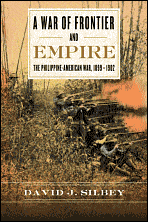
sibleyAs President Bush tries to shape his legacy in regards to the Iraq war, he should pick up David Silbey’s engaging history “A War of Frontier and Empire: The Philippine-American War, 1899-1902” (Hill and Wang; 272 pages; $26).

Though both were wars of choice, the details are quite different. Still, the generalizations that can be gleaned from Silbey’s account are eerily familiar: a quick and stunning conventional military victory turns into longer-than-expected guerrilla warfare; a failure by the United States to understand its enemy; a sense of racial superiority that enflames troops and politicians in Washington; and a native population whose loyalties seemed to change depending on the time of day.

Continue reading →

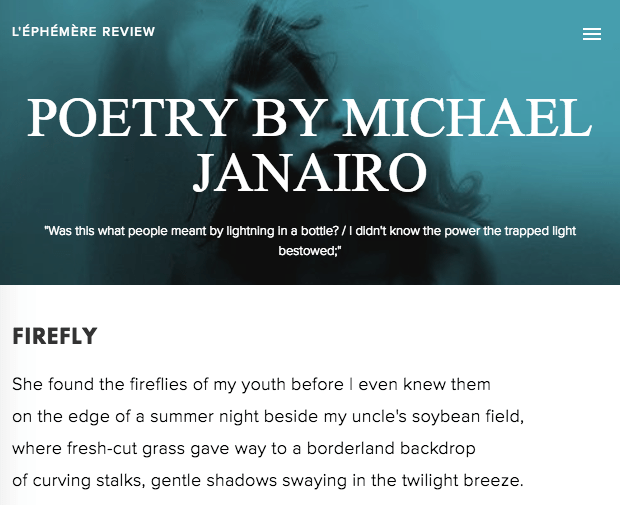
New poem: ‘Firefly’ in L’Éphémère Review

Thank you L’Éphémère Review for publishing my poem!

Screen Shot 2017-10-09 at 8.42.19 PM

Read the rest of the poem here: http://www.ephemerereview.com/michael-janairo


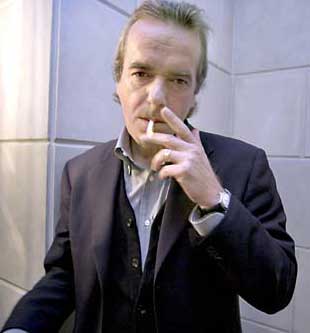
Martin Amis on life and writing

Martin Amis: “My life looked good on paper – where, in fact, almost all of it was being lived.”

― Martin Amis, Experience: A Memoir 

vintageanchor

Book review: Banana Yoshimoto’s ‘Hardboiled & Hard Luck’

The review originally appeared in September 2005 in the Albany Times Union.
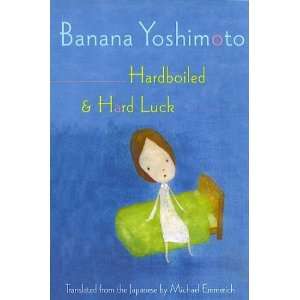
99162475_amazoncom-hardboiled-hard-luck-booksSupernatural is a natural in ‘Hardboiled’

Banana Yoshimoto became a literary sensation in Japan with her first book, “Kitchen,” in 1987. Spare prose, novella-length stories and quirky characters combined to make difficult themes, such as sexual identity and death, easily accessible and emotionally involving.

Since then, her books have been translated around the world, but a typical reaction in the United States has been: “Who? Is that her real name?”

Banana Yoshimoto is the pen name for Mahoko Yoshimoto, which she chose because of the beauty of the banana flower. More importantly for American readers, her latest book, “Hardboiled & Hard Luck” (Grove Press; 150 pages; $21; translated by Michael Emmerich) , offers another chance to get to know this talented writer.

The novella “Hardboiled” presents a fascinating use of common tropes in Japanese literature: the power of nature and the presence of ghosts.

An unnamed narrator is hiking in the mountains and seems not to have any cares – or human connections. She believes relationships end not because of feelings, but because “periods in our lives end the way seasons change. That’s all there is to it. Human willpower can’t change that – which means, if you look at it another way, that we might as well enjoy ourselves until the day arrives.”

This attitude, however, doesn’t prevent her from encountering a lover – a woman who could see ghosts – she had left and who died in a mysterious fire a month after she had moved out. Odd things happen to the narrator at a shrine, in a noodle shop and at a hotel, and then she remembers it is the first anniversary of her former lover’s death.

Though “Hardboiled” is a ghost story, it isn’t a horror story. The dead appear as living people or in dreams, and the realms of the living and the dead interact in unexpected ways, with compassion, understanding and resolution.

The narrator of the second novella, “Hard Luck,” is also a young, unnamed woman. She recounts the unreal and heartbreaking period of time in which her family comes to terms with her sister’s vegetative state and impending death.

The narrator, a college student who has put her studies on hold, even calls it “a sacred time set aside for us survivors.” (That sentiment seems so much more appropriate than the media and political circus that surrounded Terri Schiavo, who died earlier this year.)

She finds herself in the midst of an odd flirtation with Sakai, the older brother of her sister’s fiance. The fiance, too grief-stricken to be at his intended’s bedside, has returned to his parents’ home a coward. Sakai takes his brother’s place at the hospital to preserve the family’s honor, it seems. But he later admits his interest in the narrator.

Sakai, a tai chi instructor in his early 40s, is otherworldy and oddly attuned to the narrator. Through their talks, she is finally able to cry. But she knows the budding relationship won’t go anywhere. She even describes him as “weird, and kind of a fraud … cold and unreasonably cheerful, and … no sense of responsibility.”

Yoshimoto’s power as a writer is evident here, with a straightforward description that works to reveal the characters of both Sakai and the narrator.

Throughout the story, strangeness, desire and humor are combined without ever once forgetting the brain-dead sister and the family’s grief. How the narrator sees her situation is also an appropriate description of the story: “And it struck me that if anything was a miracle, it was this: the lovely moments we experience during the small, almost imperceptible periods of relief. The instant the unbearable pain and tears faded away, and I saw with my own eyes how vast the workings of the universe were, I would feel my sister’s soul.”

With these two novellas, Yoshimoto again proves her fame is well deserved. She succeeds in showing the naturalness of the supernatural and in making the peculiar not only realistic, but also touching.

The deft translation by Emmerich (who previously translated Yoshimoto’s “Goodbye, Tsugumi” and “Asleep”) should help Yoshimoto gain a broader audience in the United States.
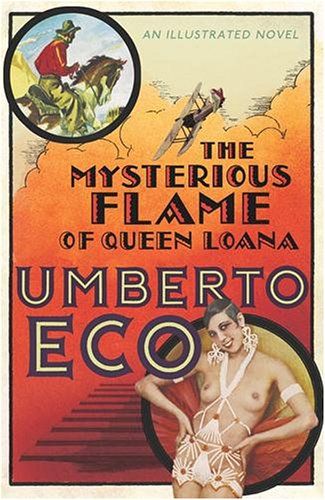
Book review: Umberto Eco’s ‘The Mysterious Flame of Queen Loana’

This review originally ran in May 2005 in the Albany Times Union.

78769-coverMemory, identity evaporate in ‘Queen Loana’
Among life’s great chores is the sorting through of old papers, books, records and magazines long ago left in the attic. Few events combine such tedium with unexpected moments of rich nostalgia, in which a single image can rise from junk and make the past profoundly present and vital.

This is the magic of the intriguing but ultimately disappointing new novel by Umberto Eco, “The Mysterious Flame of Queen Loana” (Harcourt; 469 pages; $27; translated from the Italian by Geoffrey Brock).

In Milan, Italy, in late April 1991 (soon after the end of the Gulf war) our narrator has lost his memory. What happened isn’t clear, but all he can remember are things he’s read. The first few pages are filled with references to writers such as T.S. Eliot, Agatha Christie and Arthur Conan Doyle – and those are just the easy ones to spot for someone familiar with English literature.

When a doctor asks the narrator his name, he responds with the first line of a novel by Edgar Allen Poe: “My name is Arthur Gordon Pym.” When the doctor tells him that isn’t true, he tries with: “Call me … Ishmael?”

At once, Eco reveals his smarts and sly humor.

Soon, we learn that the narrator is in his 60s, is an antiquarian book dealer and goes by the nickname Yambo. Yambo is mischievous. Having forgotten his personal life, including his relationship with his wife, he calls himself a 60-year-old virgin, even though he is a father and grandfather. His character raises the expectation of a wonderful tale of memory and identity. Unfortunately, moments of wonder are all too rare.

Yambo returns to his family’s estate in the countryside in an attempt to regain his identity by going through the stuff in the attic. What he describes we see in reprinted lyrics and illustrations from posters, newspapers, comic books and magazines from the 1930s and ’40s.

The time period is fascinating: Italian fascism, war and giddy pop culture. Yambo calls the mix of messages from the media “schizophrenic.” He says, “Allied troops were landing in Sicily, and the radio (in the voice of Alida Valli!) was reminding us that love is not that way, love won’t turn to gray the way the gold fades in a woman’s hair.”

Yambo even finds an essay he wrote that praises fascism, but he doesn’t know if he was a true believer or if he had to play it safe at school. His predicament seems rich with possibility, as if Eco is suggesting that a new, multinational war (the Gulf war) is reminding Yambo’s generation how much of the past they had to forget in order to survive the horrors of war and fascism.

Some of the novel’s best writing occurs in the retelling of Yambo’s adventure with a group of partisans, but what Eco is trying to say about these themes of struggle and violence gets muddled in the abundance of pop culture. The title even refers to a comic book, and the riveting, wartime passages aren’t sustained with the same vitality as Philip Roth’s great reimagining of Newark, N.J., in “The Plot Against America” or even John Dower’s social histories of Japan in “War Without Mercy” and “Embracing Defeat.”

A 16-page section in the back of Eco’s book cites the sources for the illustrations, and a repeated phrase says that many of the images came from the “author’s collection.”

Suddenly, all the illustrations and references are indulgent. They disrupt the novel. The particulars of Yambo’s life don’t point to any general truth of the human condition, they point to Eco. As the novel progresses, this conflation of narrator and author makes one think Eco is no longer exhibiting his pleasure of language, culture and life through writing; instead, he is writing lists about things that brought him pleasure.

In the end, the “mysterious flame” that rises in Yambo’s (or is it Eco’s?) heart from seeing the pop culture of his youth has, unfortunately, left this reader feeling cold.

Perhaps it would have been more enjoyable to sort through my old books and papers.

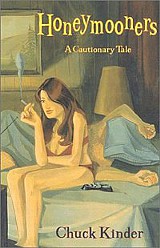
Book review: “Honeymooners: A Cautionary Tale” by Chuck Kinder

book-7121This review first appeared in the Albany Times Union (August 11, 2001)

Hilarious, loving characters in ‘Honeymooners’

Chuck Kinder’s first novel since “The Silver Ghost,” in 1978, “Honeymooners: A Cautionary Tale” ($24; Farrar, Straus and Giroux; 358 pages), is a hilarious, yet unflinching, eyes-against-the-windshield journey through years of booze, drugs, sex, friendships, lies and betrayals in the lives of a pair of promising young writers.

The freewheeling 1970s that Kinder recreates, mostly in the San Francisco Bay area, belong within the literary tradition of the moveable feast Hemingway created out of Paris in the ’20s. Kinder’s writers, Ralph Crawford and Jim Stark, live “like bold outlaw authors on the lam from that gloomy tedium called ordinary life.” Kinder both celebrates and sends up their bravura and recklessness.

Continue reading →

Coming in 2016: WB Belcher’s Lay Down Your Weary Tune

Book review: After Birth by Elisa Albert

I love this book. Get it. Read it. Now.

“After Birth” by Elisa Albert tells the story of three months in one woman’s life around a year after giving birth who befriends a former “almost” rock star/poet who is about to give birth. The narrator says of the poet: “I’m a little obsessed with her, by which I mean a lot, which I guess is what obsessed means.”

In that sentence, Albert achieves the creation of a distinctive character in her narrator: a sharp sense of humor, somewhat confessional, somewhat striving for clarity, while also somewhat muddled. Ari, the narrator, may not always be a sympathetic character (one of the first things she does is call the upstate city she lives – a fictional town called Utrecht, but an easily readable blend of Albany, Troy, Schenectady — a “shitbox”), but her language is so seductive that it can charm the reader, even in her most negative moments.

After all, Ari seems to be suffering from a kind of post-partum depression, a severe disorientation in which she feels betrayed by a world that didn’t prepare her for life after having a child, she’s lost interest in completing her doctorate in women’s studies, she feels isolated in the aforementioned “shitbox” town, and all of it has been exacerbated by having undergone a c-section operation.

If that weren’t enough, there is also that special kind of existential dread a parent faces by bringing a new life into the world: “I’m not going to pretend my kid is special, like other kids who starve and freeze and get raped and beaten and have to work in factories and get cancer from the fumes, too bad, so sad, but my kid is going to be warm and organic and toxin-free and safe and have everything he wants when he wants it and go to a good college and all is right with the world! Fuck that myopic bullshit. He’s going to suffer. He’s going to get mauled by some force I can’t pretend I can predict. We all live in the same fucked-up world.”
Continue reading →

Book review: Yasushi Inoue’s ‘Life of a Counterfeiter and Other Stories’

counterfeiterOne of the dominant characteristics of Yasushi Inoue’s rhetorical style in “Life of a Counterfeiter and Other Stories” (Pushkin Press; 144 pages; $18) in is his use of “hedging” phrases, such as “for some reason,” “I’ll never know” and “I may simply be reading too much into things.”

These phrases could be interpreted as creating a narrator who is so fraught with uncertainty that he can only suggest things with modesty rather than declare them with authority.

These stories — written after World War 2 in the early 1950s, but often looking back through the haze of memory at events that took place long before and during the war — can then be seen as a reaction against the kind of narrative certainty about Japan’s prominence in the world that led the nation into its disastrous overreach in China, Korea, and South East Asia. In that sense, his narrative hedging can be seen as an attempt to be precise about the meaning of things that can’t be known.
Continue reading →