Studying Spanish in Duolingo, I came across back-to-back exercises talking about revolution.
¿Qué es una revolución? “What is a revolution?”
Cada revolución es neuva. “Each revolution is new.”
Is this strange? Is this pointing to some kind of truth about the revolutions in Spanish-speaking countries? When I’m in Spain, especially in Catalonia, am I likely to hear talk about a revolution?
A new podcast for me this year, and for everyone, is Pod Save America, the podcast created by former speechwriters in President Obama’s administration. It acts as a tonic or a resistance in the Trump era. It seems to be a successful rallying cry so far for people who are disillusioned at the current government. It is one of the most popular podcasts now. They are even taking the show on the road. It is released twice a week, on Mondays and Thursdays, which is a little too much for me. I enjoy the Monday ones the best, probably because the hosts are Jon Lovett and Tommy Vietor, in addition to Jon Favreau, who I think do a better job than for the Thursday show when it is just Favreau and Dan Pfieffer. Favreau is usually in the role of setting things up, kind of the straight man, so it is stronger when there are two people playing off him instead of one (and Pfeiffer does have a hesitating way of speaking that isn’t great for audio). Also, as the show develops further, they have to find a way of better integrating the guest interviews with the introductory news punditry round-up: too often they steal the thunder from their guests, and so why listen to their guests?
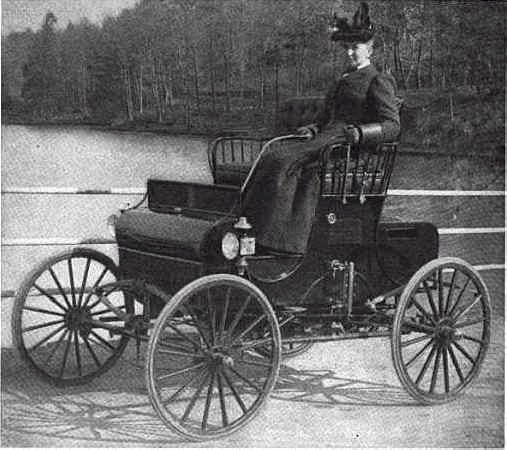
A horseless carriage (1901 Kidder Steam Wagon by the Kidder Motor Vehicle Co. in New Haven, Conn.) from the New England Historical Society.
One thing I often say to visitors to the contemporary museum where I work is that when they look at something they don’t quite understand their brains will try to make meaning out of the new or strange thing by equating it to things they already know. That is, the experience of something new is filtered by the past: we are always moving forward with our eyes on history.
I recently heard or read something (maybe it was a podcast?) that said language works in a similar way: a new thing is named by its relationship to the past. Thus, we didn’t have “cars” at first, we had “horseless carriages.”
The podcasters were bringing this up in relationship to the clumsy name we now have for the latest vehicular technology: the self-driving vehicle. I have a name for it: automobile, which is a combination of the Greek for “self,” and the Latin for “movable.”
Yes, of course, I know people call their Priuses (Priuii?) and SUVs and Beamers “automobiles,” but I’d argue that the term has been wrong all long. None of those vehicles drove themselves. They all required an operator, or a driver, which is also an interesting word. And the act of driving, of course, is what makes a term “self-driving” necessary, because we understand “automobile” to mean a vehicle that is driven (though that isn’t literally what it means).
This kind of word repurposing is nothing new. The word “car” itself is quite old, from the fourteenth century, referring to vehicles with wheels in Latin (carrus), and also thought to be related to a similar word “carriage,” which just means to carry and is said to be from the twelfth century.
Anyway, this is just to say that it doesn’t seem unlikely that soon-ishly (maybe in twenty years) English speakers will finally be using the “automobile” correctly, in reference to self-driving vehicles.
A young person I know recently said something along the lines that Twitter was going down the drain. I don’t where that idea came from. I’ve been using Twitter since Sept. 19, 2008. (which is longer than 99.755% of all other Twitter users, according to http://twopcharts.com/howlongontwitter).
Perhaps the young person was thinking of sponsored contents like the ad here from the Alliance for Quality Education of New York. I ignore most Twitter ads but this one got me because of the words “ET HE UGLY RUTH.” (more…)


 A new podcast for me this year, and for everyone, is