NaNoWriMo and Me

I’ve never officially signed up for NaNoWriMo — National Novel Writing Month — though I know many people who have, and today my social media feeds are filled with folks sharing their words counts.

I’d love to do it. And I agree with this great advice from John Scalzi that it can be done — you can crank out enough words for a novel-length manuscript in a month. And I also agree with these words of wisdom from Larry Brooks in a 2010 GalleyCat article: “Don’t finish. Make this the start of something.”

But I want to use this time to try something I haven’t done before: Outline a novel first.

I’ll let you know how it goes.

On writers and (not) reading

I’m sure I read a quote somewhere recently that said something along the lines that eventually a writer must decide to be either a reader or a writer.

Has anyone seen this quote? Do you know what I’m talking about?

The idea behind the quote struck me as intriguing (and maybe a little self-serving). After all, the common wisdom is that all writers must be readers. You have to read the language to know how to use the language, to know the history into which your words are joined. The thing is in my daily life I face a constant dilemma: when I’m not working at my day job, I can read OR write (or watch TV, sleep, do household chores, pay bills, cook, do laundry, buy groceries, socialize, etc.). Most often, though, it is choice between reading and writing. Writing usually wins out, and the guilt-inducing pile of books (in print and ebooks) grows larger and larger.

If I didn’t read, though, and if that quote that I think I saw recently that I can’t place now has any merit, then maybe I don’t have to feel guilty about not reading all the books that I haven’t been reading. (Though it isn’t clear to me if that quote means I can excuse my guilt when I’m not writing because I’m watching TV, sleeping, socializing, etc.)

The thing is, though, I’ve always been a big reader. A slower, reader, sure, but I have a large appetite for books. One of the best things anyone has ever said about me is that for me reading is like plugging me in.

There was a time when I only read big, old books: Les Miserable, Brothers Karamazov, Anna Karenina, Hunchback of Notre Dame, Crime and Punishment. There was a time when I plowed through novels and short stories, consuming the published works of single authors such as Raymond Carver, Kazuo Ishiguro, Michael Chabon, Jayne Anne Phillips, Tolkien, and people whose new books I often consume right away, like Margaret Atwood. Lately, it’s taking me longer and longer to read anything.

My most recent purchase, the 1998 comic book series called Stone, which incorporates Philippine folklore in its story, has taken me more than two weeks just to read the first issue, and its not long at all — and its mostly pictures, too.

In some ways, with all the reading I do on the web — news, social media, work-related articles — I might be doing just as much reading, if not more, as I was doing when I was in graduate school, when the web was but a wee thing.

So instead of me thinking that my reading has slowed way down because of my age and my new need for reading glasses, I like to think it is because I’m a writer first and need my free brain time for not only the act of writing but also the thinking and processing and nurturing of the ideas, characters, actions and sensations that go into my writing.
On Broadway

This is cool. My words have made it to the bright shining lights of Broadway.

My former Times Union colleague Steve Barnes (thanks, Steve!) sent me a photo from outside the Lyric Theater, where a revival of the classic show “On the Town” has just opened in previews.

The photo shows a poster that quotes the Times Union (alas not my name, but those are my words) from a review of the musical that I wrote when the same production was presented last year at Barrington Stage Theater in the Berkshires.

Pretty cool, to be blurbed on Broadway.

IMG_2466.JPG

Fact-checking family stories

I’m not in the habit of fact-checking family stories, despite the countless times (as a journalism student and journalist) I’ve heard: “If your mother tells you she loves you, check it out.”

So it was more of a fluke than a deliberate act when I came across a document linked to what I’ve come to think of as the precipitating moment of my family’s coming to America.

A google search led me to the digitized book “Official Register of Officers and Cadets: United States Military Academy,” which included not only my grandfather (a cadet from 1926 to 1930), but also the conditions upon which he became a cadet.

Screen Shot 2014-09-21 at 5.13.02 PM

Continue reading →

On West Point and my father’s 60th reunion

My father, Max, and my brother Anthony at West Point.

My father, Max, and my brother Anthony at West Point.

This past weekend, my father celebrated his 60th college reunion at the US Military Academy at West Point.

He attended the long weekend of activities with my older brother who, unlike me, had vivid memories of when we lived on post (I was but a wee toddler, and yet I remain a proud Army brat and always feel an upsurge of emotion when I’m at West Point).

I met up with them on a Sunday morning, after all the official reunion events were over. I met some of my father’s classmates in the lobby of the hotel as they were getting ready to head back to their respective homes. We went into town for a brunch at Andy’s Diner (a place that has been around since 1903 and which many Plebes went to, though my father had never been there. I gave them copies of a short fiction anthology of military sci-fi that includes one of my stories. We toured the West Point Museum.
Continue reading →

Moss Hart, Act One and the persistence of You Can’t Take It With You

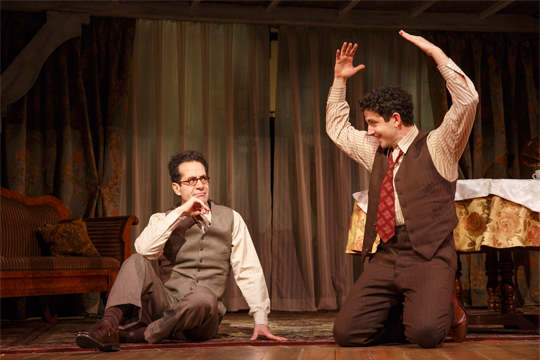
Tony Shalhoub as George S. Kaufman and Santino Fontana as Moss Hart in "Act One" at Lincoln Center (Photo by Joan Marcus)

Tony Shalhoub as George S. Kaufman and Santino Fontana as Moss Hart in “Act One” at Lincoln Center (Photo by Joan Marcus)

“Act One” officially opens at Lincoln Center later this week, but this weekend I saw a preview showing of it. It’s good. Not great — the story of the life of Moss Hart, the playwright who grew up poor in the Bronx and had only a eighth-grade education (he had to go to work) but who went on to win the Pulitzer Prize.

The production is magnificent — a rotating set, great period costumes, top-notch acting from Tony Shalhoub (as an older Moss Hart, narrating Our Town-style; as the father of the 11-year-old Moss Hart; and as George S. Kaufman, who works with the young adult Moss Hart); the young adult Hart is strongly played by Santino Fontana, who may be best known as the voice of the evil prince Hans in the movie musical “Frozen”; and Andrea Martin, nailing multiple roles.

The play (written and directed by James Lapine), though, moves a bit slowly in, yes, Act 1, and feels very much like a less madcap Moss Hart play — a little dated in trying to stay true to the source material, Hart’s 1959 autobiography about his Dickensian early 20th-century life. What also seems dated is the ease of access Hart had to some of the brightest minds of his day, despite his lack of education. Perhaps a 21st century analogy would be talented computer coders and programmers who drop out of college and gain access to the best and brightest in that field.

What was most interesting to me though was what happened before I saw the show. I wanted to see the play in no small part because I had acted in Hart and Kaufman’s “You Can’t Take it With You” in high school, back in the 1980s.

At work, one of my coworkers, when I told her I was going to see the play, said, “I performed in ‘You Can’t Take it With You’ in high school.” She’s in her 60s, which means her high school days were in the 1960s. And also at work, another colleague said, “I was in ‘You Can’t Take it With You’ in high school!” That colleague, however, is an intern, a college senior, and her high school days were in the 2000s.

There it was, three generations of people all working at the same place all having been in the same play, which was first performed 1936 and won the Pulitzer in 1937.

So if you love the theater, and if you’ve been in any of Hart’s plays (such as “The Man Who Came to Dinner”), then this play is highly recommended.


The writing game is a waiting game

When I was in college, my friends and I often joked about the life of being of writer, especially the low pay, imagining a scenario in which a publisher would say something like  … “Great story. Here’s a dollar. What else ya got?”

What we didn’t talk about was all the waiting that goes along after sending stories out, and the sometimes in-between emails that can come it.

So on March 17, I got an email from a writers contest telling me of my status in the contest. I was told my story wasn’t lost, that others had been told they hadn’t won, and some had gotten Honorable mentions, but that I was in the “hold” category — which I had never knew existed. The thing is, in one of the write-ups announcing the contest, it had said that winners would be notified around the end of March, so I wasn’t expecting to hear anything — certainly not as soon as March 17. Continue reading →

A few words to a young writer about arts journalism

I was recently interviewed via email by a high school student interested in arts and entertainment journalism. Here are some of the questions and answers:

Q: What different professions have you held in order to get where you are now?
A: I had a journalism internship at the Bellingham Herald in Bellingham, Wash., when I was still a college student majoring in journalism, but I also taught English in Japan, edited a phone book, worked as a copy writer for an advertising agency, and worked as a copy editor at a newspaper before becoming the arts and entertainment editor, all the while I wrote freelance reviews of books, plays and concerts.

Q: What classes did you take, throughout high school and college, to put you in a place to get the job you wanted?
A: In my high school, I was on the honors track, meaning I got to take AP classes (history, chemistry, English, calculus), as well as other advanced-level class, but I also took theater courses throughout high school. In college, I was a journalism major, but also took many courses in political science, philosophy and English. In graduate school, I earned a master’s of fine arts in creative writing, but also studied Japanese language and culture.
Continue reading →

February 2014 Story of the Month

Vote for The Duck! Do so before the poll closes on March 2, 2014.

Bartleby Snopes Story of the Month

The voting for the February 2014 Story of the Month is now open. Read all of the February stories and then vote for your favorite. Voting will close on March 2nd. Please only vote once.

The winning story will earn an automatic spot in the 12th Issue of our semi-annual magazine due out in July 2014.

View original post