I am still in disbelief that Mike Jarboe is gone. I am so glad to have read so many stories about him and tributes to him, and that his family knows how many people he has touched and how deeply. Everyone who’s ever met Mike Jarboe has a Mike Jarboe story. Here are some of the things that come to my mind.
We worked together on the Times Union news copy desk for about six years. One of the best things for me about those years were the “slot/rim” meetings I had with him.
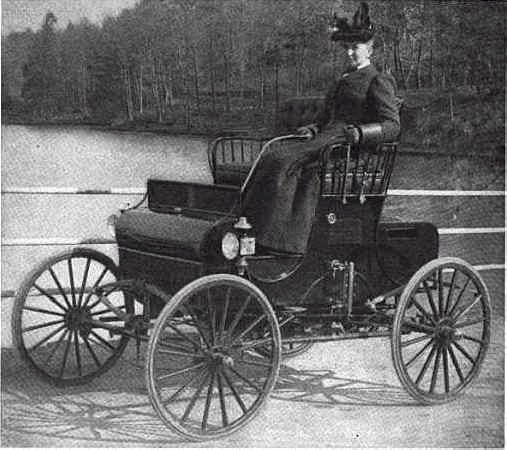
A horseless carriage (1901 Kidder Steam Wagon by the Kidder Motor Vehicle Co. in New Haven, Conn.) from the New England Historical Society.
One thing I often say to visitors to the contemporary museum where I work is that when they look at something they don’t quite understand their brains will try to make meaning out of the new or strange thing by equating it to things they already know. That is, the experience of something new is filtered by the past: we are always moving forward with our eyes on history.
I recently heard or read something (maybe it was a podcast?) that said language works in a similar way: a new thing is named by its relationship to the past. Thus, we didn’t have “cars” at first, we had “horseless carriages.”
The podcasters were bringing this up in relationship to the clumsy name we now have for the latest vehicular technology: the self-driving vehicle. I have a name for it: automobile, which is a combination of the Greek for “self,” and the Latin for “movable.”
Yes, of course, I know people call their Priuses (Priuii?) and SUVs and Beamers “automobiles,” but I’d argue that the term has been wrong all long. None of those vehicles drove themselves. They all required an operator, or a driver, which is also an interesting word. And the act of driving, of course, is what makes a term “self-driving” necessary, because we understand “automobile” to mean a vehicle that is driven (though that isn’t literally what it means).
This kind of word repurposing is nothing new. The word “car” itself is quite old, from the fourteenth century, referring to vehicles with wheels in Latin (carrus), and also thought to be related to a similar word “carriage,” which just means to carry and is said to be from the twelfth century.
Anyway, this is just to say that it doesn’t seem unlikely that soon-ishly (maybe in twenty years) English speakers will finally be using the “automobile” correctly, in reference to self-driving vehicles.
Thank you, re:asian magazine, for including me in the “firsts” issue!
The poem touches upon things I’ve been thinking about since grade school when I first read the phrase “benevolent assimilation” as a U.S. description of its colonial policy with the Philippines.
The magazine has also published a photo I took of the home my Lolo — grandfather — grew up in Cavite.
Here’s an excerpt from the poem:
Something like fear structured my feelings around the word
Philippines and whatever it was that connected me to it
Check out the full poem on the re:asian website here and let me know what you think — either here or on the re:asian site.
Ajapa Sharma, one of the co-founding editors of the journal, writes in the introduction:
When we read Michael Janairo’s submission “Instructions for Astronauts” for this issue, it resonated with some of the themes of our favorite space-based films and series. SyFy’s series based on James S.A. Corey’s Hugo award winning books, The Expanse has been our staple since season 2 of the series started airing in February. Against all criticisms, we’ve also thoroughly enjoyed Ridley Scott’s Prometheus and are eagerly waiting to watch Alien: Covenant later this year. Janairo’s poem captured elements that have traditionally been a part of science fiction’s visual corpus and his stellar voice quality made it all the more adaptable for a film. Working with Michael’s poetry, it became evident that good visual material can only come from excellent writing. The visual, after all, is an innovative translation of a textual script. The hope is that the video will become a medium through which Janairo’s poetry can travel far and wide.
The short version: Bullies who favor guns over culture distort facts so they can gut federal arts funding; here are some facts.
The news
“The president’s budget would eliminate the NEA’s $148 million budget, the NEH’s $148 million budget and the CPB’s $445 million budget, as well as $230 million for the Institute of Museum and Library Services, which supports libraries and museums across the country.”
Here we go again. A GOP budget plan to ax arts funding. Right-wingers cheering it on, saying things like arts are elitist and that people who want arts should pay for it themselves . This all seems to be a reflection of a couple different ways of looking at the world: the libertarian one, in which everyone needs to do everything for themselves (except maybe national defense?); and a kind of anti-intellectualism in reference to culture that can be summed up as “if I don’t understand it, it must be elitist.”
I’m reminded of a story told by a former newspaper colleague who recounted a meeting with an adult person in public. That person, recognizing her from her photo in the newspaper, said something like, “You write those movie reviews, right? You must be a millionaire.”
I sent the following letter to my three federal representatives, my member of the House and my two senators. I used a form letter provided by the American Alliance of Museums, of which I am a member, as a starting point. I am not in the habit of writing letters to my representatives. Nor am I in the habit of marching in the streets and in the airport, but I have done all of these things since January 21, 2017, because what is happening in America is not normal. And the current administration’s stated plans to ax the National Endowment for the Arts and the National Endowment for the Humanities strikes me as just as petty, short-sighted, and mean-spirited as anything else to come out of it so far. If you find some value in the NEA and NEH, or in this letter, please contact your own representatives to let them know.
Thank you for all you have done and continue to do to fight against the new administration and its unconstitutional ways. Also, thank you for your support of the arts in general, and of the Capital Region in particular.
On Friday night at an art gallery opening at Collar Works Gallery in Troy, NY, I met a young college graduate who is pursuing her dream as an artist. She remembered meeting me when I was the arts editor at the Times Union, the main newspaper in the Capital Region, and she was a high school student whose art work I chose to feature in the newspaper. That was a moment in her life that gave her the courage to pursue her dream.