Review: ‘The Secret History of Wonder Woman’ by Jill Lepore

91xyaczlfwlWonder Woman came into my life in the form of Lynda Carter in the TV series of the mid-1970s. Not being that into comic books, I didn’t pay her much attention until the Patty Jenkin’s directed film came out last year. The 2017 movie reminded me that Wonder Woman has been a firm part of my consciousness throughout my life, often with the theme song playing in my head (Wonder Woman, the world is waiting for you…).
I never thought much about the people behind her creation, and so The Secret History of Wonder Woman by Jill Lepore, published in 2014, was a fascinating read, especially Wonder Woman’s ties to such important figures in the history of the American feminist movement like Margaret Sanger, who opened the first birth control clinic in 1916 (and was arrested for it, along with her sister, who went on a hunger strike during her incarceration).

Continue reading →

SFPA announces 2018 Rhysling Awards

Congratulations to the 2018 Rhysling Award winners!

These are the best speculative poems of 2017, as voted on by members of the Science Fiction Poetry Association (I am a voting member). This was my first time voting for the awards (and my first time being nominated, for the long poem “Instructions for Astronauts.” I enjoyed all these winning poems, and think it’s great that Mary Soon Lee won in both categories, including for a poem published in the same new journal I was published in, Mithila Review.but I still think Brandon O’Brien’s “Birth, Place” from Uncanny Magazine 18 deserves more recognition. You can read it here.

It is especially poignant that the Sara Cleto’s poem was published in the long-time fan favorite journal Mythic Delirium which, after twenty years, closed up shop with its April 2018 issue. The win is a testament to Mike Allen’s vision and talent and hard work.

Out of 83 short poems, and 63 long poems, only three won in each category. Click on the titles for links to the poems to read them. Enjoy!

Short Poem Category

First Place
“Advice to a Six-Year-Old”
Mary Soon Lee • Star*Line 40.2

Second Place
“How to Grieve: A Primer for Witches”
Sara Cleto • Mythic Delirium, May

Third Place
“Gramarye”
F. J. Bergmann • Polu Texni 12/26/17

Long Poem Category

First Place
“The Mushroom Hunters”
Neil Gaiman • Brainpickings 4/26/17

Second Place
“For Preserves”
Cassandra Rose Clarke • Star*Line 40.4

Third Place
“Alternate Genders”
Mary Soon Lee • Mithila Review 9

Book review: ‘Insurrections’ by Rion Amilcar Scott

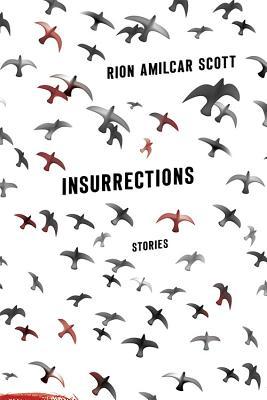
insurrections-coverI recommend the story collection Insurrections by Rion Amilcar Scott.

The stories offer glimpses of life in the fictional town of Cross River, Maryland, a largely black settlement founded in 1807 after the only successful slave revolt in the United States.

In “Good Times,” a troubled man with a wife and child finds his way back into the good graces of his family through the help of a neighbor and a ratty old Cookie Monster costume. In “Everyone Lives in a Flood Zone,” a man searches for a brother who is linked to criminals in a flooded out section of town and finds unexpected solace with strangers.

And in “Juba,” a young man is mistaken for a pot dealer named Juba, and gets arrested. Angered, he tracks down Juba and finds not only a pot dealer, but a man on a mission to capture and save the dying language of Cross River. He is even translating the Bible into the language that used to be spoken by the black residents of Cross River.

What Scott achieves with this story, and many others in the collection, is to let readers experience the strangeness and joy of these kinds of unexpected encounters. The narrator of “Juba,” for example, is on his way to a job interview when he is arrested. The  police action—they throw the narrator to the ground when arresting him—echoes the kind of violence against black people in America that has given rise to the social media hashtag #LivingWhileBlack. That Scott is able to take his story (and his readers) through  such an undercurrent of social injustice and violence, while also bringing his narrator deeper into a drug world, and toward concerns of language, and not just language in general but a specific kind of language of a people in a specific (if fictional) place that is being lost.

What an amazing place to take a story. Scott is a writer that earns a reader’s trust and willingness to go wherever his stories lead. It is one of the main reasons why spending time in Cross River is so enjoyable. Check out the book now. You can buy it from the publisher, University Press of Kentucky. A new collection of Cross River stories, titled The World Doesn’t Require You, is slated for publication in 2019.

Rion Amilcar Scott won the 2017 PEN/America Robert W. Bingham Prize for Debut Fiction for Insurrections. His website is http://www.rionamilcarscott.com and you can also find him on Twittter at https://twitter.com/ReeAmilcarScott.

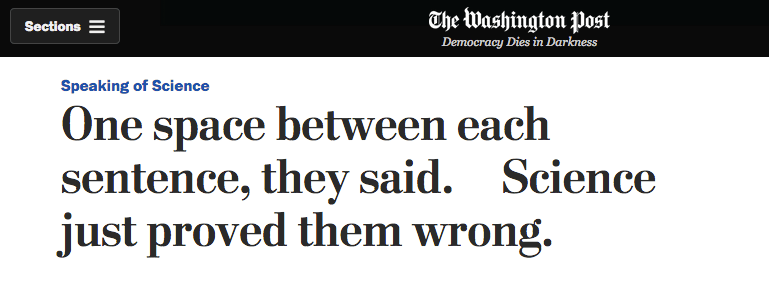
Fun story, bad science journalism

Screen Shot 2018-05-10 at 9.57.02 PM

I recommend reading this story, but I don’t recommend believing it.

Here’s why:

You can tell from the headline that it will be fun, and the writer gets to play with using multiple fonts and spacing of letters. It looks like Dada poetry. Dada is often fun. The gist of it is that a scientific study says using two spaces after a period makes a text more readable than one space after a text (though some argue, and I agree, that this two-space rule is a holdover from typewriters and monotype fonts (in which each letter takes up the same width, regardless of it being an “i” or a “w”). With today’s word processors, fonts are no longer monotype (and so two spaces aren’t needed).

First thing, though, is that I was taught as a journalism student that science doesn’t  “prove” things; rather, it provides evidence that support theories. So when I read this headline, I think: Bad journalism! (Knowing how hard newspaper work is these days, especially for the copy editors who write the headlines, I can be forgiving. Though it is also this kind of use of the word “prove” in a scientific setting that allows for the slippage between the common understanding of “theory” as meaning a guess and the scientific understanding of the word “theory” as meaning a hypothesis that can be tested to find evidence in support of the hypothesis.)

Then there’s the experiment itself. The sample size—60 students—is far too small for the amount of certainty the story and the headline give it. Again, this is the same kind of bad journalistic reading of science that allowed for the word “proved” to be used in the headline.

Even worse is how the students were tested using a device called the Eyelink 1000, which tracks eye movements as someone reads. As the article states:

Most notably, the test subjects read paragraphs in Courier New, a fixed-width font similar to the old typewriters, and rarely used on modern computers.

In other words, the students were tracked while reading a font for which people should use two spaces after a period, but which most people don’t use.

So which side are you on? One space or two?

Duolingo talking about a revolution

Studying Spanish in Duolingo, I came across back-to-back exercises talking about revolution.

  • ¿Qué es una revolución? “What is a revolution?”
  • Cada revolución es neuva. “Each revolution is new.”

Is this strange? Is this pointing to some kind of truth about the revolutions in Spanish-speaking countries? When I’m in Spain, especially in Catalonia, am I likely to hear talk about a revolution?

National Book Critics Circle Announces 2017 Award Winners

Poetry
Criticism
Autobiography
Biography
Nonfiction
Fiction
The John Leonard Prize
The Nona Balakian Citation for Excellence in Reviewing
The Ivan Sandrof Lifetime Achievement Award

‘The Advanced Ward’ on StarShipSofa

starshipsofa-logoA short story I wrote a few years ago that was published in the anthology Veterans of the Future Wars has been recorded as is now available on StarShipSofa, the Audio Science Fiction Magazine.
Check it out on StarShipSofa or listen to it below (the story is introduced by Tony C. Smith and read by Spencer DiSparti):

Thank you StarShipSofa!

My first Amazon order

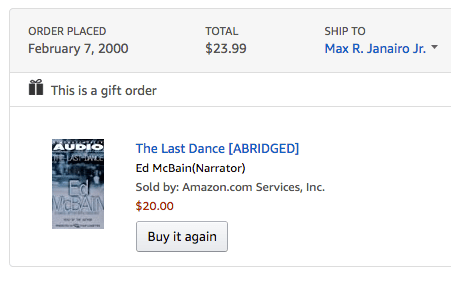
Screen Shot 2018-02-05 at 2.35.02 PM
It’s a thing. On the internet. People have been posting about their very first order on Amazon. Looks like I bought an audio book as a gift for my father eighteen years ago. Reminds me how much I enjoyed Ed McBain’s novels of the 87th Precinct. He wrote dozens of them. Though McBain—which was a pseudonym for Evan Hunter (which was a legal name change, as McBain/Hunter was born Salvatore Albert Lombino)— may also be just as well known for writing the novel Blackboard Jungle, which was made into the 1955 film.

National Book Critics Circle Announces Finalists for 2017 Awards

IMG_8528.jpgThe National Book Critics Circle has announced today winners of three prestigious prizes and nominees in nonfiction, biography, autobiography, poetry, criticism and fiction. The awards will be announced on March 15.

  • Carmen Maria Machado’s debut story collection, Her Body and Other Parties (Graywolf), is being honored with the John Leonard Prize, which recognizes an outstanding first book in any genre. It is named in honor of founding NBCC member John Leonard.
  • Charles Finch is being awarded the 2017 Nona Balakian Citation for Excellence in Reviewing.
  • The Ivan Sandrof Lifetime Achievement Award will go to John McPhee.
Here is the complete list of NBCC Award finalists:

Continue reading →