The first thing that caught my eye at the gas pump the other day as the phrase “Free meat,” right there on the upper right of this sign. As gas fumes swirled in the cold air around me, which was tinged with the taste of the rock salt that covers roads, tires and car bodies, I couldn’t help but think that nothing sounded less appetizing than the desperation of a phrase like “free meat.”
Of course, that wasn’t the end of the line, but in my years as a headline writer I’ve come to respect linebreaks in a way a poet can understand. That the end of a line is an occasion for meaning. So I focused on “free meat,” before I realized that what the sign was really talking about was “free meat sauce” to go on the hot dogs, as well as “fixin’s.” So though the apostrophe may be correct as a way to signify a dropped letter, in this case a “g,” it also has the unintended consequence of making the word seem like it is a possessive (as in these signs).
Then I saw the hotdogs. Are they supposed to be cute and charming, dressed like chefs about to cook themselves? Is that why their smiles seem so forced, their eyes seemed to be crossed (as if to suggest lack of intelligence?), and the dog on the left is giving the finger? Are these subversive hot dogs?
Anyway: As I finished filling the tank, I was happy for this momentary distraction. It’s a lot better than the pumps that have the screens and the volume blaring at you. All I could think was that someone nearby was sitting at a desk and designed that thing, and someone else approved of it.
NOTE:If you are a fan of Person of Interest and haven’t seen Season 4 Episode 15 don’t read this because it is probably full of spoilers. It also contains wild speculation that probably has nothing whatsoever to do with the ongoing narrative of the show.
Here’s the IMDb description of “Person of Interest” Season 4 Episode 15, “Q&A”: “Reese tries to protect a software programmer with a mysterious second life, but it’s unclear which side of her life the threat is coming from. Meanwhile, Claire, a young hacker that Finch protected, reaches out to him for aid.”
Though “Person of Interest” has been praised as “powerful political science fiction” by i09, I was watching it to see artwork by my spouse, Deborah Zlotsky.
So in the show, her paintings were used as set decoration for a fictional software company in which much of the main plotline (about the programmer with a mysterious second life) is set. Though most viewers probably wouldn’t pay all that much attention to the artwork hanging in the background, it was what I was looking for — and the use of the work reveals a strange hidden narrative about one of the workers in the software company.
A scene from “Person of Interest” Season 4 Episode 15 “Q&A”
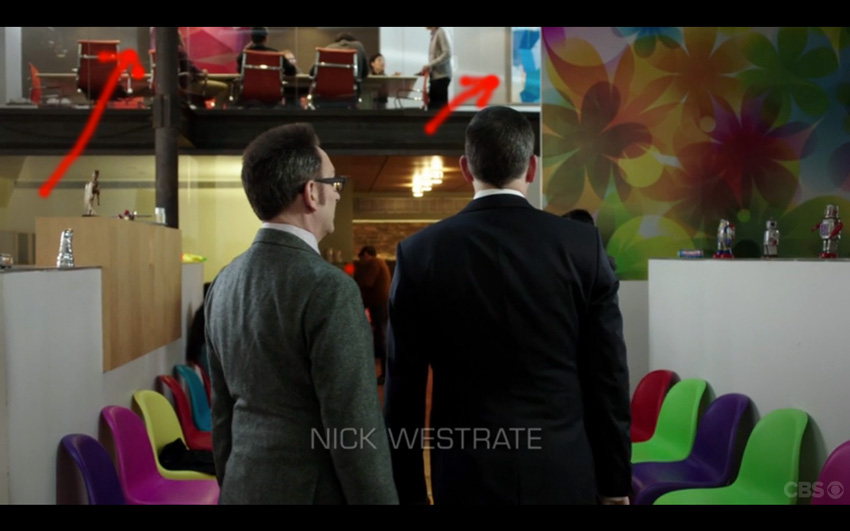
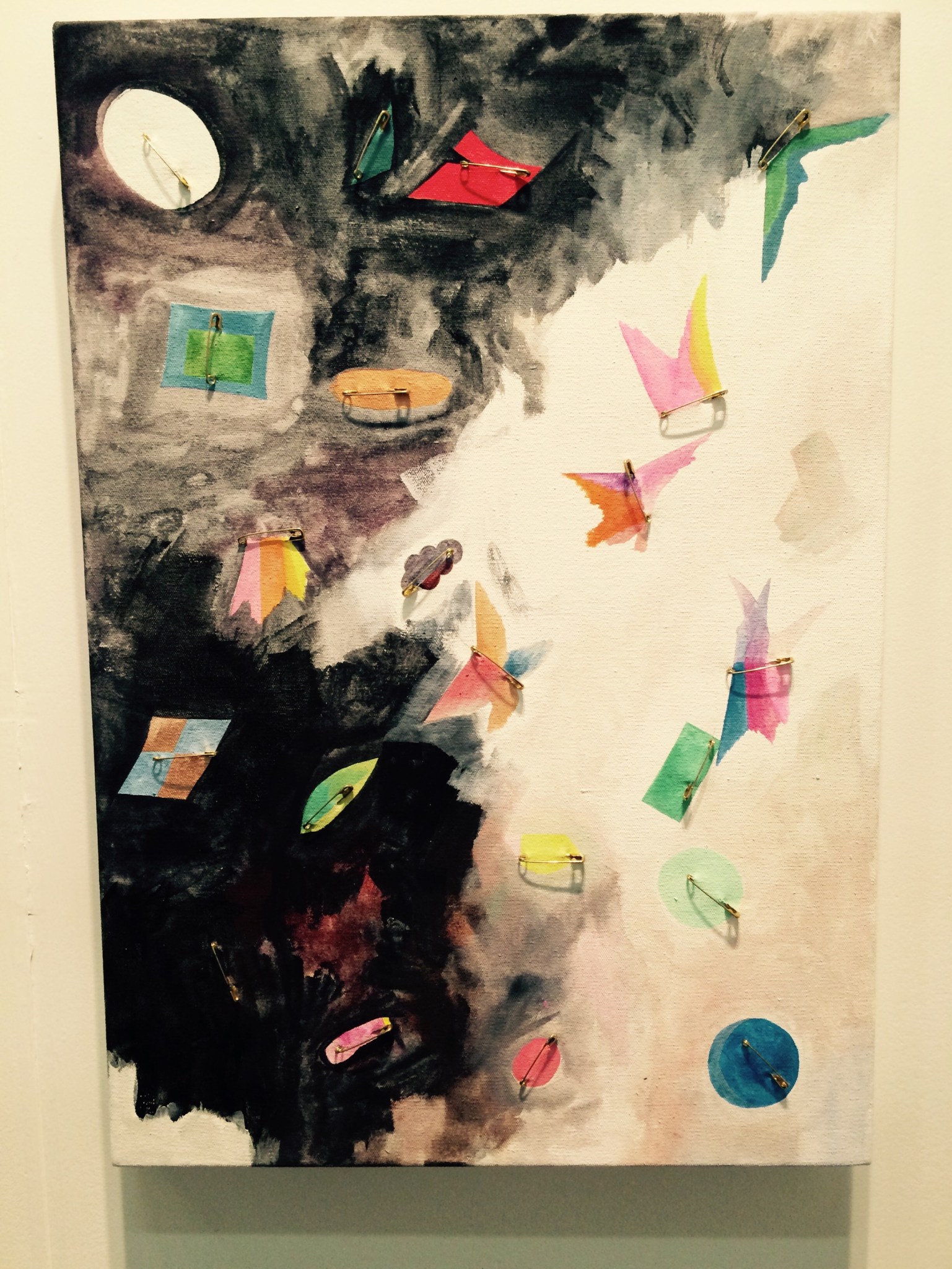
Here’s Finch (Michael Emerson) and Reese (Jim Caviezel) in an early scene of the episode. Up there in back, in what looks like a conference room, are two paintings. The one the left is one called Everything Must Go; the one on the right is called Not so happy, yet happier. Yes, my wife’s paintings are abstract, colorful, and with geometric and biomorphic forms. If you compare what you can see of the paintings in this screengrab from the show, though, with how they are presented here on my wife’s website and here on my wife’s gallery’s website, you’ll see the paintings aren’t hung as intended.
A scene from “Person of Interest” Season 4 Episode 15 “Q&A”
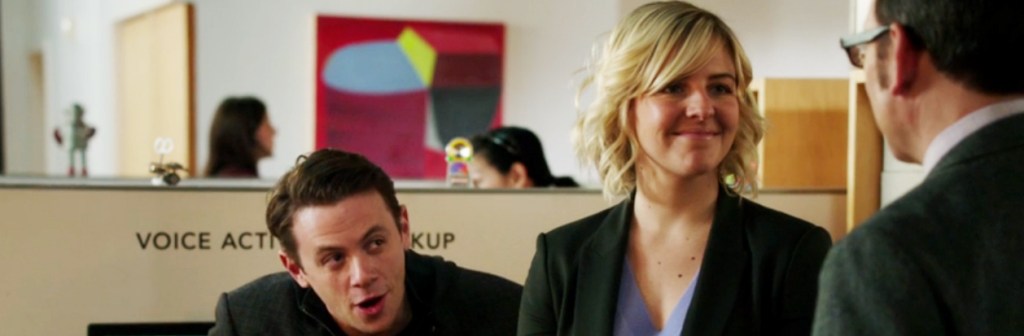
This painting, shown during the beginning of the show as the credits are still coming onscreen, is called Situational, three, and can be seen better here. The clear view of this painting was a surprise, because I imagined that the paintings would’ve been used as they are in the first image (way in the background), or how they are used in the one below (just behind a closeup of a character so as to be unrecognizable). Keep Situational, three in mind: It will appear again. Plot bit: The guy (played by Nick Westrate) is the founder of the software company; the woman (played by Heléne Yorke) is the CEO.
A scene from “Person of Interest” Season 4 Episode 15 “Q&A”
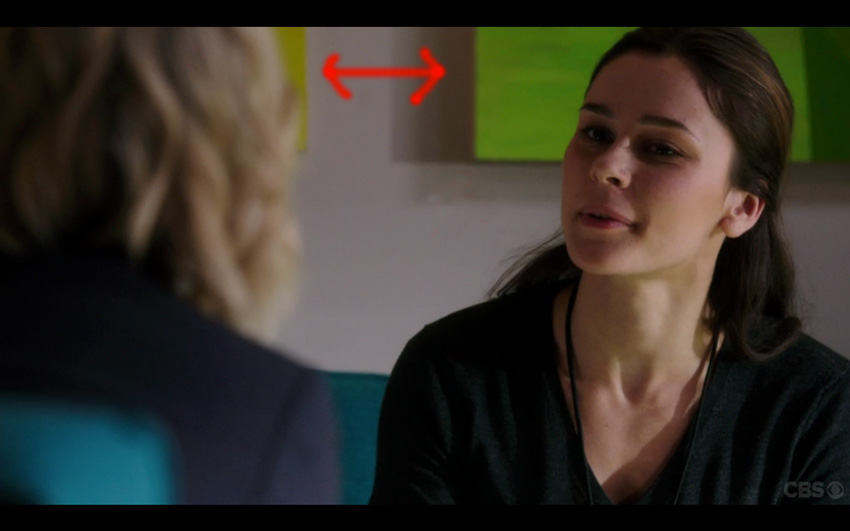
OK, not much to see here by way of paintings. I show this because this is how I imagined the paintings would’ve been used. Some story plot here: This image shows the programmer with a secret life (played by Bella Dayne) being scolded by her boss (the CEO) for looking into something a co-worker told her to forget about.
A scene from “Person of Interest” Season 4 Episode 15 “Q&A”
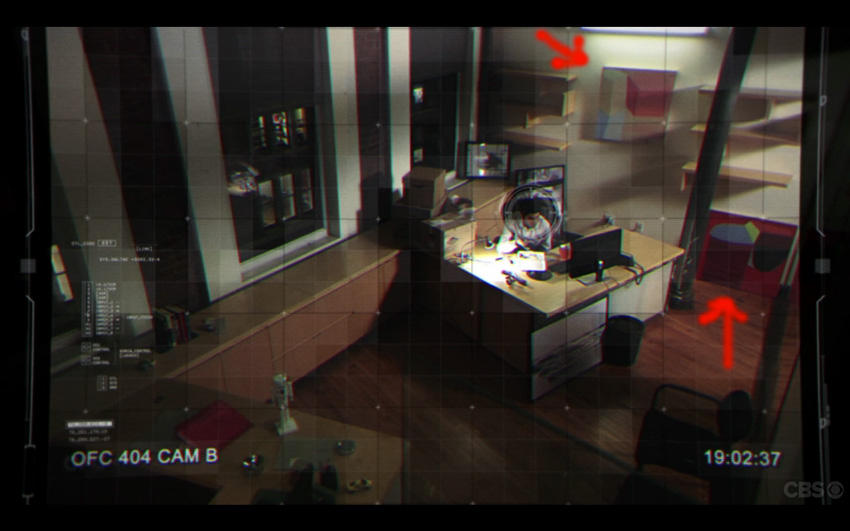
Another plot point: This is the new office of the co-worker who told the programmer to forget about something. He’s gotten a promotion. That means he’s moved out of the open office area (which was presided over by Situational, three) and into his own office. Note, moving into his own office space means he gets two of my wife’s paintings: The one hanging on the wall is called Situational, one, and a closer look at it is available here; the one one the floor is, yes, the previously seen Situational, three. The show doesn’t explain why that painting, which was previously looking over the open-office area, gets to be used by one employee in his own office. I can think of two reasons: The set directors wanted to imply a hidden narrative that this worker in addition to getting his own office also gets to have this cool work of art in his office, not only as decoration but also as a reminder of where he had come from. OR, maybe, the set directors didn’t think anyone would notice.
A scene from “Person of Interest” Season 4 Episode 15 “Q&A”
Here’s a closer look at Situational, one and the actor Omar Maskati, in the role of the guy who got the promotion. This painting, too, will show up again later.
A scene from “Person of Interest” Season 4 Episode 15 “Q&A”
This is my favorite screenshot. Here’s the programmer with the secret life (she’s an underground mixed-martial-arts fighter in her spare time to help pay for her sister’s chemotherapy, of course) in a fight with some bad guys in her CEO’s office. Yes, those are the paintings that were only visible as small rectangles of color in the earlier close-up photo of Bella Dayne. The painting on the left is Situational, two, and the painting on the right is Situational, four. Why is this fight happening? It has something to do with the software company’s founder being a bad guy with henchmen, unbeknownst to the programmer or even the CEO. But did the guy who got the promotion know about it?
A scene from “Person of Interest” Season 4 Episode 15 “Q&A”
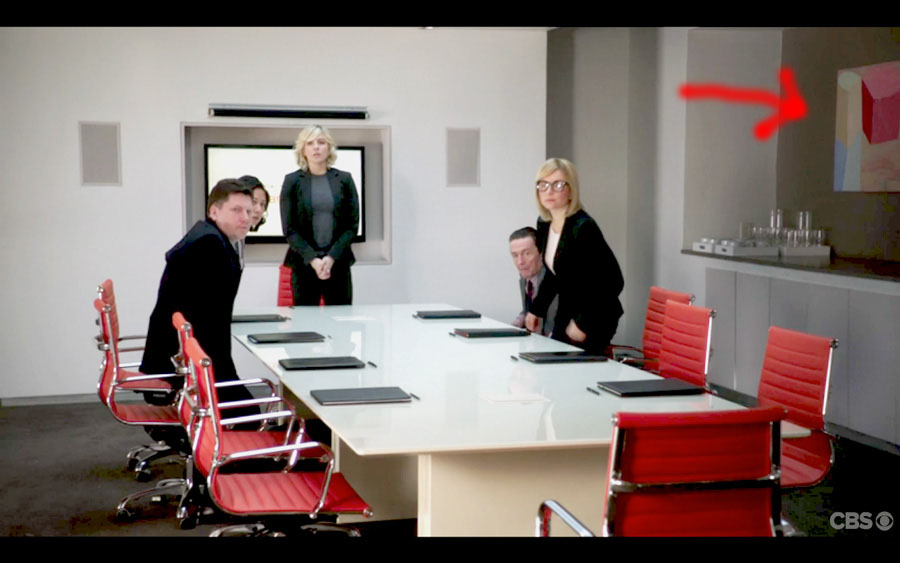
This image is from the final scene of the episode. Gone, now, is the founder (for being a bad guy), so the CEO is in the boardroom in charge of everything. Absent from the room is the guy who got the promotion. On the wall at right, however, is the painting Situational, one that had been in that guy’s new office. What’s happening here now? It seemed like the whole guy getting the promotion was just a red herring, and that the real bad guy was the founder. So what happened to the character that he’d lose the painting in his office? Even more so, this is a conference room, and yet in one of the first scenes there was a conference room that had two different paintings. If you look at this photo here and the first photo above, you’ll see that both conference rooms feature the same kind of red chairs. Could this be the SAME conference room?
If it is the same conference room, then I think I’ve uncovered a hidden narrative about this episode having to do with the company and my wife’s paintings. In this software company, it isn’t just people that get promotions, but paintings get promotions, too. As one moved from the open office into a private office, another moved from a private office into the more visible conference room (and replacing one painting). So the question I’m left with is: What happened to the painting Everything Must Go, which was visible in the first photo but has been replaced by Situational, one in this photo? Is this another mystery for “Person of Interest?” Perhaps its the opening for a spinoff show: “Painting of Interest?” (Or, maybe, I’m reading too much into it, and the makers of the show didn’t think anyone would notice.)
For your enjoyment, two videos about the Philippine-born, NYC-based artist Paul Pfeiffer. He’s represented by Paula Cooper Gallery in NYC. Of interest to me is his exploration of images of basketball, especially considering the long history of basketball in the Philippines. (A quick history of it can be found here.)
Yan Lei Landing-Shanghai, 2007, at Tang Contemporary Art, BeijingThomas Huber, vis-a-vis, at Galerie SkopiaMilton Avery, 1951Sarah Cain at Galerie LelongGlenn Kaino, A Shout Within a Storm, 2014, at Honor Fraser
Here’s a detail shot of one of my wife’s paintings that shows a passage I hadn’t noticed during the opening of her show at Kathryn Markel Fine Arts (when the gallery was crowded). Enjoy!
(Detail) Deborah Zlotsky, Tulips and chimneys, 2014, at Kathryn Markel Fine Arts through Oct. 11Deborah Zlotsky, Tulips and chimneys, 2014; Oil on canvas, 60 x 72 in.
This season’s major museum exhibitions take a decidedly American bent. New revelations about Georgia O’Keeffe’s deep connections to Lake George are at the Hyde Collection in Glens Falls. A recalibration of Winslow Homer and an interesting late period for George Innes fill the Clark Art Institute in Williamstown, Mass.
Meanwhile, Thomas Cole, Asher Durand and Albert Bierstadt highlight the Festival of American Romantics at the Fenimore Museum in Cooperstown, while other Hudson River School artists are featured at the Albany Institute of History & Art. James McNeill Whistler’s fertile period in Venice is explored at the Arkell Museum in Canajoharie.
But if you’re on a tight budget, interested in experiencing art outside of museums or focused on contemporary art, there’s a wealth of free exhibits dotting the region all summer. The array of talent is impressive. Here’s a sampler:
2013 Annual Summer Exhibition at Art Omi
It’s hard to beat this lineup. Nathan Carter draws inspiration from decaying technological devices, pirated communications systems, rogue nation states and rolling blackouts. Known for her hand-blown glass terrariums, Paula Hayes interprets the Columbia County farmland with a series of planters. Always over-the-top, Erwin Wurm presents a typically acerbic portrait made with cast aluminum and enamel. Tom Doyle contributes five large-scale works cast in bronze from wood, while Allan McCollum revisits his “Perfect Vehicles” series from the ’80s. Opening reception: 1 to 5 p.m. Saturday; exhibition runs through October. Art Omi, 1405 Route 22, Ghent. Sculpture park is open every day during daylight hours. Visitor center and gallery 11 a.m. to 5 p.m. 392-4747; http://www.artomi.org(more…)
Mikael Darni’s contest entry, titled “Patrón Pendant Lamp.”
Art and alcohol mix in a contest sponsored by the tequila company Patron.
The Art of Patron contest asked artists nationwide to transform the brand’s glass bottle into a work of art. Only 25 were selected as semifinalists. Mikael Darni, a graduate of the School of Visual Arts in New York City and a resident of the Catskills in Acra, Green County, is one of the 25, and the only one from the greater Capital Region. Read more about Darni at www.mikaeldarni.com.
As part of his entry, Darni wrote: “The beauty of the handcrafted Patrón bottle inspired a one of a kind, reverse hand-painted, “Illuminated” work of art. As done by the turn of the century glass artists, Galle, Handel and Pairpoint.”
Now through May 31, people 21 and older can visit ArtofPatron.com to register and then view the 25 semi-finalists and cast a vote. The 10 designs selected as finalists will each win $1,000 and advance to the final round and a chance at $10,000. The grand-prize winner will be announced in late June.
The Sterling and Francine Clark Art Institute in Williamstown, Mass., has announced that it recently received a significant gift of art from New York-based collectors Frank and Katherine Martucci, including an important group of eight paintings by American landscape painter George Inness.
The gift of eleven paintings and five drawings was accepted by the Clark’s Board of Trustees during a meeting in March and represents one of the more significant donations of art to the Institute since its founding. The Martucci collection also includes oil paintings by Eastman Johnson and Gaston Latouche, as well as an early watercolor landscape by Piet Mondrian and five works by 19th century Italian genre painter Mosè Bianchi.
The Clark will present the eight Inness landscapes in an exhibition, “George Inness: Gifts from Frank and Katherine Martucci,” which will be on view June 9-Sept. 8. The presentation will unite the new acquisitions with two works by Inness, “Wood Gatherers: An Autumn Afternoon” and “Home at Montclair,” which were purchased by Sterling Clark and have been a part of the institute’s collection since 1955.
“George Inness has no greater contemporary advocate than Frank Martucci, who has studied Inness’s aesthetic philosophy, assembled a wonderful collection of his work, and supported the publication of the complete catalogue of Inness’s work in 2007,” said Michael Conforti, director of the Clark. “As we prepare for the reopening of our museum galleries next year, it is very exciting to contemplate the added depth these works by George Inness will bring to our American paintings collection, focused on the two other great painters of the late nineteenth century America, Winslow Homer and John Singer Sargent.”
'Blue Lagoon' Mixed Media on Paper 38 x 50 by David Miller (Courtesy Sorelle Gallery)
David Miller, a painter who lives in Saratoga Springs and is a retired professor from Skidmore College, has recently joined the roster of artists represented by the Sorelle Gallery at Stuyvesant Plaza in Guilderland, the gallery has announced.
A 2001 Times Union review of a retrospective exhibition of his work at the Tang Museum said: “His joy infuses the gestural, calligraphic line and color on his canvases, much as it did for the Abstract Expressionists, to whom he clearly owes a debt.”
For more about Miller and the Sorelle Gallery, click here.