Category: Writing
-
Fun story, bad science journalism
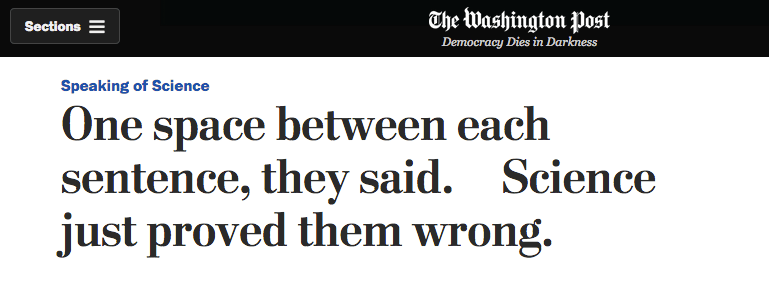
I recommend reading this story, but I don’t recommend believing it.
Here’s why:
You can tell from the headline that it will be fun, and the writer gets to play with using multiple fonts and spacing of letters. It looks like Dada poetry. Dada is often fun. The gist of it is that a scientific study says using two spaces after a period makes a text more readable than one space after a text (though some argue, and I agree, that this two-space rule is a holdover from typewriters and monotype fonts (in which each letter takes up the same width, regardless of it being an “i” or a “w”). With today’s word processors, fonts are no longer monotype (and so two spaces aren’t needed).
First thing, though, is that I was taught as a journalism student that science doesn’t “prove” things; rather, it provides evidence that support theories. So when I read this headline, I think: Bad journalism! (Knowing how hard newspaper work is these days, especially for the copy editors who write the headlines, I can be forgiving. Though it is also this kind of use of the word “prove” in a scientific setting that allows for the slippage between the common understanding of “theory” as meaning a guess and the scientific understanding of the word “theory” as meaning a hypothesis that can be tested to find evidence in support of the hypothesis.)
Then there’s the experiment itself. The sample size—60 students—is far too small for the amount of certainty the story and the headline give it. Again, this is the same kind of bad journalistic reading of science that allowed for the word “proved” to be used in the headline.
Even worse is how the students were tested using a device called the Eyelink 1000, which tracks eye movements as someone reads. As the article states:
Most notably, the test subjects read paragraphs in Courier New, a fixed-width font similar to the old typewriters, and rarely used on modern computers.
In other words, the students were tracked while reading a font for which people should use two spaces after a period, but which most people don’t use.
So which side are you on? One space or two?
-
RIP Storify

The Storify logo appeared to be an “S” or was it begin and end single quotes? Storify is at an end. For the past seven-plus years, I’ve made 34 Storify stories by combining posts from Twitter, Facebook, Instagram, and YouTube to tell stories in different ways. At the time I started, it felt like a great possibility for storytelling in general (check out this Storify) and the future of journalism in particular.
Storify will come to an end on May 16, 2018—and so will access to all the stories people created over the years.
So here’s a look back before it leaves.
- My most-read Storify, with nearly 3,000 views, was reactions to the 2011 Super Bowl Halftime Show: https://storify.com/mjanairo/super-bowl-half-time-show
- Another well-read Storify was the breaking news of reports of a gunman on the campus of the University at Albany in 2013 (it turned out to be a man in law enforcement visiting his son): https://storify.com/mjanairo/lockdown-rumor
- Sometimes I used Storify to save social media conversations I found interesting, as in this one about the Filipino identity of Rico, the main character in Robert Heinlein’s Starship Troopers: https://storify.com/mjanairo/starship-troopers-rico-and-identity
- Another one I used often as a cautionary tale for social media users is called The Aurora Twitter Fail, in which a fashion brand touted its Aurora dress for trending on social media on the day of the mass shooting at the movie theater in Aurora, Colorado: https://storify.com/mjanairo/the-aurora-twitter-fail
-
Thank you, SFPA, for the Rhysling nomination!
My poem “Instructions for Astronauts” has been nominated for a Rhysling Award by the Science Fiction and Fantasy Poetry Association (SFPA)!
The poem was originally published in the Mithila Review along with a video produced by Salik Shah that includes my voice reading the poem. The Rhysling nomination means the poem will be published again, this time in The 2018 Rhysling Anthology of all nominated poems.
-
‘The Advanced Ward’ on StarShipSofa
 A short story I wrote a few years ago that was published in the anthology Veterans of the Future Wars has been recorded as is now available on StarShipSofa, the Audio Science Fiction Magazine.
Check it out on StarShipSofa or listen to it below (the story is introduced by Tony C. Smith and read by Spencer DiSparti):
Thank you StarShipSofa!
-
2018 Rhysling Awards eligibility
I had two poems published in 2017 that are eligible for the 2018 Rhysling Awards, which are awards for speculative poetry. These awards must be nominated by a member of the Science Fiction and Fantasy Poetry Association (I’m a member, but people can’t nominated their own poems).
Eligible in long-poem category:
- “Instructions for Astronauts,” Mithila Review Issue 8, Spring 2017, published April 2017, http://mithilareview.com/janairo_04_17/
Eligible in short-poem category:
- “Firefly,” L’Éphémère Review: Issue VII: Crepúsculo, October 2017, http://www.ephemerereview.com/michael-janairo
Thanks for checking them out!
-
2017 in Review in Publishing


Thank you goes out to all the readers out there who’ve read my stuff, and to the editors and publisher who put my poetry and fiction out there for the world to read. (more…)
-
The week ahead, according to predictive text
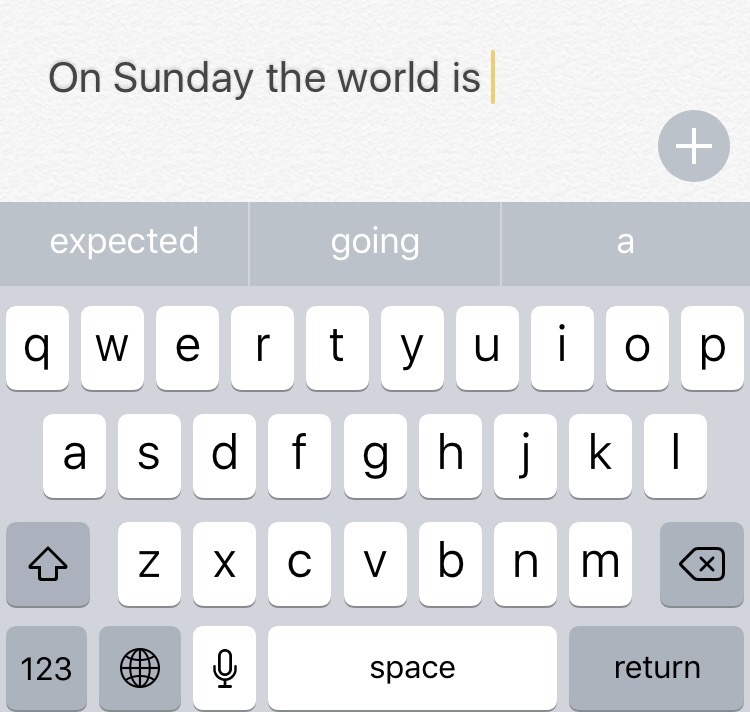
Just how predictive is predictive text?
To find out I began a sentence in my iPhone’s Notes app with the word “On” followed by the day of the week and the phrase “the world.” For the rest of the sentence I selected one of the three words suggested by the predictive algorithm to find out what’s in store for all of us.
Here is what I discovered:
-
New poem: ‘Firefly’ in L’Éphémère Review
Thank you L’Éphémère Review for publishing my poem!
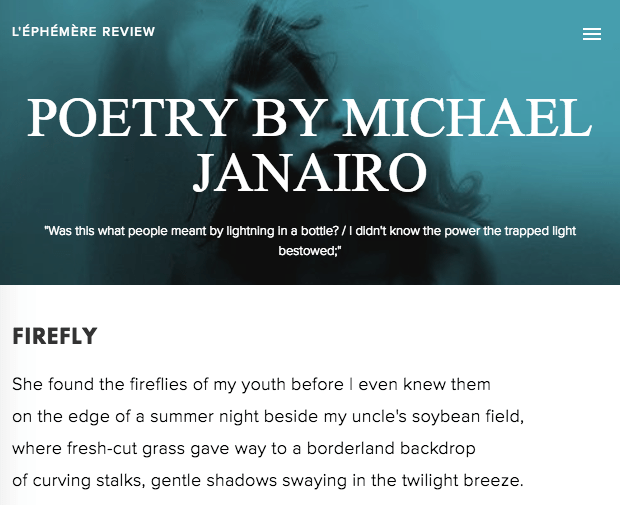
Read the rest of the poem here: http://www.ephemerereview.com/michael-janairo
