Thank you L’Éphémère Review for publishing my poem!
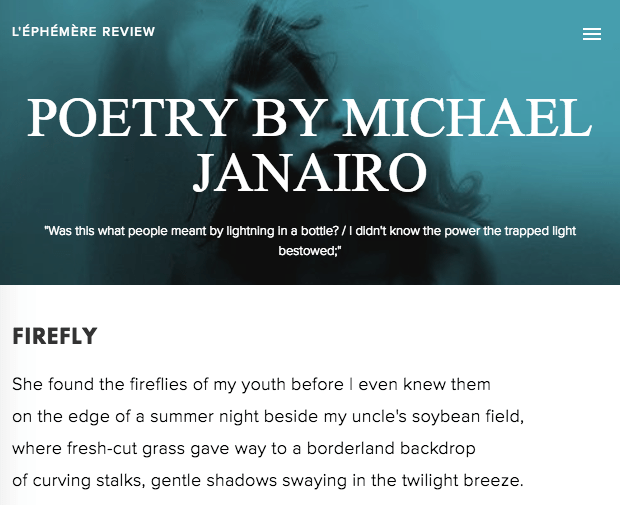
Read the rest of the poem here: http://www.ephemerereview.com/michael-janairo
Thank you L’Éphémère Review for publishing my poem!
Read the rest of the poem here: http://www.ephemerereview.com/michael-janairo
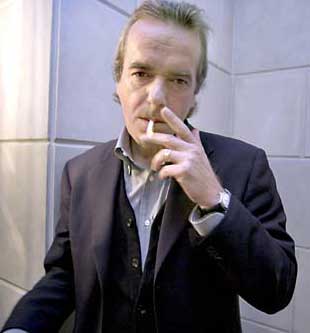
Martin Amis: “My life looked good on paper – where, in fact, almost all of it was being lived.”
― Martin Amis, Experience: A Memoir
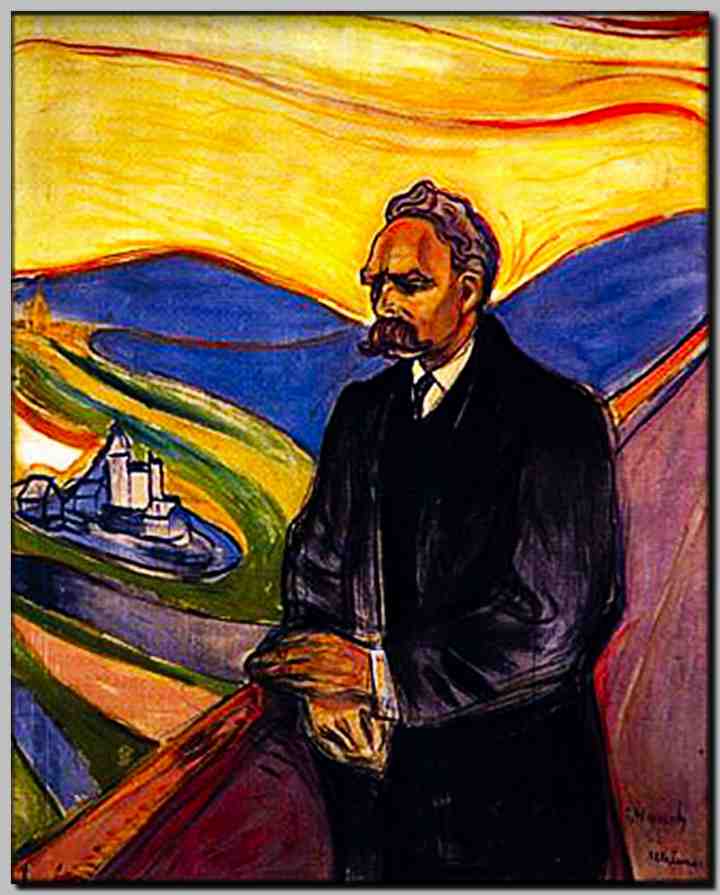
“The author must keep his mouth shut when his work starts to speak.”
—Friedrich Nietzsche

As many writers know, there are all sorts of way submissions of stories and poems to journals and magazines get submitted. Few places take postal mail. Lots of places take email. Most, though, take neither and use some kind of online form, such as Submission Manager, or Submittable.
 Here’s the thing about a service like Submittable: You get to see whatever you have out in the world awaiting a judgment in one fell swoop.
Once a piece of writing has been submitted, the first status you see is “Received.” This status brings writers a glorious sense of satisfaction, accomplishment and peace — for all of about 10 seconds. Then, as the days, weeks, and months (yes months) crawl by, and that status “Received” keeps saying “Received,” the writer begins to wonder, “Why are they ignoring me?” or “How can they let my work just sit there?” All a writer wants is a chance and some acknowledgment. “Received” comes to mean more than being ignored; it means you don’t have a chance (yet) and you aren’t being acknowledged (yet). “Received” can be very frustrating.
It should get better when a status changes to “In-Progress.” The first sight of it does produce of frisson of excitement — someone’s reading me! However, that can be quickly replaced with a sense of dread — someone’s reading me!
That second feeling persists, though, as the status remains “In-Progress.”
What happens next may not seem fair, or wonderfully fair. If the writing is “Accepted” or “Declined” (or if it is “Withdrawn” by the author) that status doesn’t appear — at least if the writer is looking only at the submissions that are still “active.” Of course, you could switch tabs and look only at the “Accepted” writing — and if there’s a new one, the one that had just disappeared from the “active” list, then much celebration can ensue. Or you could look at the “Declined” list, and, if the new one is there, instead, I suppose the opposite of much celebration will then ensue.
No matter what, though, Submittable is supposed to make tracking writing submissions easier — and it removes what in the pre-Internet days was just months of months of not knowing until a SASE returned. Now there are statuses that can appear frozen in place for months and months, and each one can fill a writer with various levels of anxiety and dread.
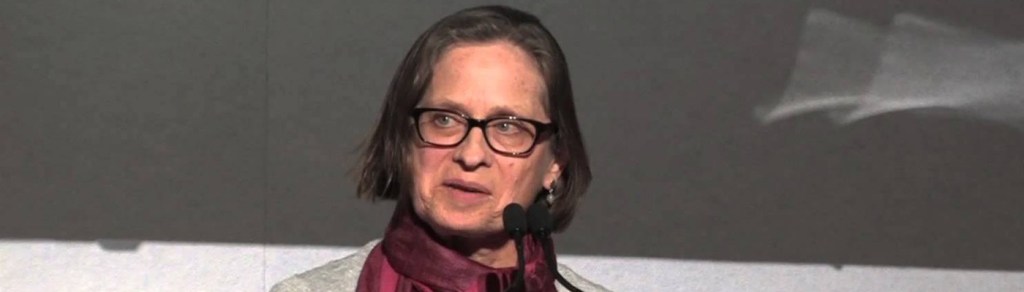
For five weeks, on Tuesday nights in October and the beginning of November, I’ve spent a few hours in a room at the University of Albany with a few fellow writers and the multiple-award winning writer Lydia Davis.
My classmates — all published writers — were talented and well-spoken, even if a few weren’t as gregarious as others.
Speaking of gregarious, Lydia encouraged all of us to track metaphors in are daily lives — to include them in the things we overhear and read as part of our writer’s diaries — and that common abstract words like “gregarious” were derived from metaphors, because the word stems from a Greek word for “herd.”
As for what to include in our writer’s diaries, Lydia suggested that she writes “whatever goes into my mind that interests me.”
Most of the class was a writers workshop, reading fellow writers’ stories-in-progress and talking about them, which is always interesting to me. And we got to know each other by sharing what we’ve read in the past year — and that “reading diary” moment generated a long reading list for me.
In terms of talking about the craft of writing, Lydia shared what she called five different kinds of narration, which she wasn’t sure if she had ever seen before but thinks she may have made up as a way of taking a writerly approach to reading to discover what a writer was doing in certain passages (and how a reader may want to make use of those moments in his or her own writing).
These five categories aren’t anything new, but they offered a practical way of reading:
1. Action: characters do things
2. Comment: a reflection on something from a point of view
3. Description: things shown through sensory detail
4. Dialogue: characters talk
5. Exposition/back story: things get explained, or histories get filled in
It was all good stuff, and I enjoyed my fellow students’ writings immensely.
So even though this all came right in the crush of the new website I have been working on, I’m glad I was able to take part. And it was free, courtesy of the New York State Writers Institute.
I’ve never officially signed up for NaNoWriMo — National Novel Writing Month — though I know many people who have, and today my social media feeds are filled with folks sharing their words counts.
I’d love to do it. And I agree with this great advice from John Scalzi that it can be done — you can crank out enough words for a novel-length manuscript in a month. And I also agree with these words of wisdom from Larry Brooks in a 2010 GalleyCat article: “Don’t finish. Make this the start of something.”
But I want to use this time to try something I haven’t done before: Outline a novel first.
I’ll let you know how it goes.
 I’m sure I read a quote somewhere recently that said something along the lines that eventually a writer must decide to be either a reader or a writer.
Has anyone seen this quote? Do you know what I’m talking about?
The idea behind the quote struck me as intriguing (and maybe a little self-serving). After all, the common wisdom is that all writers must be readers. You have to read the language to know how to use the language, to know the history into which your words are joined. The thing is in my daily life I face a constant dilemma: when I’m not working at my day job, I can read OR write (or watch TV, sleep, do household chores, pay bills, cook, do laundry, buy groceries, socialize, etc.). Most often, though, it is choice between reading and writing. Writing usually wins out, and the guilt-inducing pile of books (in print and ebooks) grows larger and larger.
If I didn’t read, though, and if that quote that I think I saw recently that I can’t place now has any merit, then maybe I don’t have to feel guilty about not reading all the books that I haven’t been reading. (Though it isn’t clear to me if that quote means I can excuse my guilt when I’m not writing because I’m watching TV, sleeping, socializing, etc.)
The thing is, though, I’ve always been a big reader. A slower, reader, sure, but I have a large appetite for books. One of the best things anyone has ever said about me is that for me reading is like plugging me in.
There was a time when I only read big, old books: Les Miserable, Brothers Karamazov, Anna Karenina, Hunchback of Notre Dame, Crime and Punishment. There was a time when I plowed through novels and short stories, consuming the published works of single authors such as Raymond Carver, Kazuo Ishiguro, Michael Chabon, Jayne Anne Phillips, Tolkien, and people whose new books I often consume right away, like Margaret Atwood. Lately, it’s taking me longer and longer to read anything.
My most recent purchase, the 1998 comic book series called Stone, which incorporates Philippine folklore in its story, has taken me more than two weeks just to read the first issue, and its not long at all — and its mostly pictures, too.
In some ways, with all the reading I do on the web — news, social media, work-related articles — I might be doing just as much reading, if not more, as I was doing when I was in graduate school, when the web was but a wee thing.
So instead of me thinking that my reading has slowed way down because of my age and my new need for reading glasses, I like to think it is because I’m a writer first and need my free brain time for not only the act of writing but also the thinking and processing and nurturing of the ideas, characters, actions and sensations that go into my writing.
When I was in college, my friends and I often joked about the life of being of writer, especially the low pay, imagining a scenario in which a publisher would say something like … “Great story. Here’s a dollar. What else ya got?”
What we didn’t talk about was all the waiting that goes along after sending stories out, and the sometimes in-between emails that can come it.
So on March 17, I got an email from a writers contest telling me of my status in the contest. I was told my story wasn’t lost, that others had been told they hadn’t won, and some had gotten Honorable mentions, but that I was in the “hold” category — which I had never knew existed. The thing is, in one of the write-ups announcing the contest, it had said that winners would be notified around the end of March, so I wasn’t expecting to hear anything — certainly not as soon as March 17. (more…)

The Colorado Kid by Stephen King
My rating: 3 of 5 stars
The TV show Haven brought me to this tale, which was more of a story about stories — a kind of using fiction to figure out a kind of aesthetic — that makes a clever distinction between stories that are good for the news media (ones that have only one thing strange about them and that can be summed up easily) versus stories that don’t work in the news media, that is stories that are too strange or unresolved or have too many points in them to be easily summed up.
(more…)
