This review originally appeared in the Times Union on March 1, 2007.
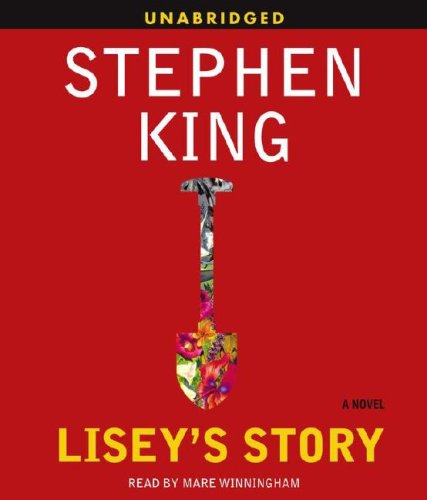
“Lisey’s Story” by Stephen King. Read by Mare Winningham. Unabridged, 19 hours, 16 CDs. Simon & Schuster. $49.95.
In ancient Greek drama, deus ex machina was used when the plot got so out of control that only divine intervention could resolve it. “Lisey’s Story” is the opposite.
Lisey is the widow of a famous author still dealing with grief two years after his death. Her loneliness is convincing, as is the magical place — Boo’ya Moon — where her husband found inspiration and confronted horrors.
What bedevils the plot, though, is an insane stalker who terrorizes Lisey for her husband’s papers. This one-dimensional, inexplicable character clearly arrives for some anti-divine intervention to create chaos. King, however, eventually keeps the plot tidy and unsurprising.
Winningham does a winning job of conveying Lisey’s melancholy as well as other characters’ madness.
You can read the full text here, and here are some of my favorite nuggets.
Hard times are coming, when we’ll be wanting the voices of writers who can see alternatives to how we live now, can see through our fear-stricken society and its obsessive technologies to other ways of being, and even imagine some real grounds for hope. We’ll need writers who can remember freedom – poets, visionaries – realists of a larger reality.
…
Books aren’t just commodities; the profit motive is often in conflict with the aims of art. We live in capitalism, its power seems inescapable – but then, so did the divine right of kings. Any human power can be resisted and changed by human beings. Resistance and change often begin in art. Very often in our art, the art of words.
The challenge for writers (and readers) and humans (and thinkers) is to confront the questions about what is real and do we live in ways that make us fully human (as opposed to subjects or objects)? How can we work toward alternatives?
This review originally appeared in the Times Union on Jan. 12, 2012.
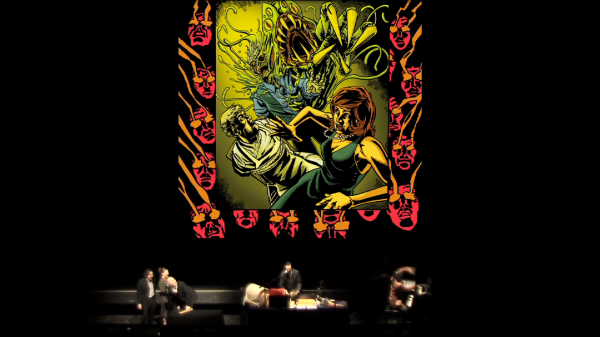
A scene from “Intergalactic Nemesis”
“The Intergalactic Nemesis” has landed at Proctors in Schenectady with an answer to the question, “What exactly is a ‘live-action graphic novel’?”
That’s how “Nemesis” bills itself, and though that term may bring to mind Christopher Nolan’s “Batman” series of movies, “Nemesis” is a stage-play hybrid: part radio show and part slide show.
Three actors at microphones voice multiple characters, while a Foley artist creates sound effects from objects on the tables before him — such as shoes, crinkled paper and even a box of macaroni and cheese — and a keyboardist maintains a dramatic score. Meanwhile, one comic book image after another is projected on a screen that towers above the people. The show uses more than 1,200 images.
The story is set in 1933 and reporter Molly Sloan, her assistant Timmy Mendez and a mysterious and heroic librarian named Ben Wilcott join forces to thwart the impending invasion of sludge monsters from the planet Zygon, who are aided by the evil hypnotist Mysterion.
The show has plenty of charm. A lot of that has to do with watching the quick work of Foley artist Buzz Moran and his delighted expression when he shakes a metallic sheet to create booming sounds of thunder.
Other fun moments come from the multiple voices the actors assume for different characters, especially when those characters are having a dialogue and one actor does both voices. The actor Chris Gibson stands out in this regard, as he hams up the maniacal laughter of the evil Mysterion, who is often in dialogue with Wilcott.
Silences are also effectively used, as when a revelation leaves the characters dumbfounded and the actors say nothing as the screen shows one surprised face after another. Also of note are the humorous ways the three actors create crowd conversation noise at a fancy party and on a street in Tunisia, and how they create the sound of applause by gently slapping their cheeks.
The show has enough of these moments to make up for some of its weaknesses, such as an overlong and static first act. A lot happens in that act, and I don’t want to give it away, but it does more to set up situations in which the characters react them to, instead of revealing to us who these characters are and what motivates them. In that regard, the second act is much better. I also wished that more of Tim Doyle’s images were better drawn, because too often the expressions and body positions seemed awkward and distorted.
One of the difficulties of this hybrid show is knowing what to watch: the images or the actors and Foley artist. In some ways, it seems as if it is playing against too much nostalgia for a clear focus. But if you’ve never seen a Foley artist at work, then this a must-see. Best of all, it is appropriate for audiences of all ages, from those who’ve never known a world without iPhones to those who once gathered around the wireless (radio, that is) for nightly news and entertainment.
This review originally appeared in the Times Union on Jan. 2, 2007, long before the Brad Pitt movie came out.
“World War Z,” by Max Brooks. Read by a full cast. Abridged, 6 hours. Random House Audio. $29.95.
The stellar cast includes Alan Alda, Carl Reiner, Mark Hamill, Henry Rollins, John Turturro, Rob Reiner and Brooks as the one compiling interviews with survivors of a worldwide war between zombies and humans.
While the variety of locales — China, Israel, South Africa, Canada, the United States, Cuba, Chile, Finland, Greenland, Barbados, Japan — puts to shame any James Bond story, the book lacks suspense.
Instead, it has realism to emphasize how the zombie wars upend how people live and what they hold sacred.
The best example occurs in South Africa, where a dreaded apartheid-era figure comes up with a plan to save the country by sacrificing parts of the population. Though most of the politicians are aghast, they accept it once the unnamed but recognizable Nelson Mandela figure approves.
The performances emphasize this human quality of physical and psychological struggle.
Why is it that some of the greatest sci-fi out there has everything to do with war?
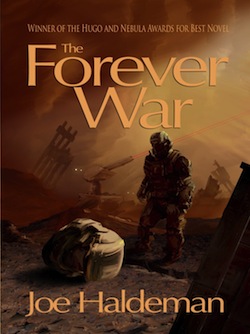
I’m thinking of “Star Wars,” “The Forever War,” “Old Man’s War,” “War of the Worlds,” for example (and those are just some of the ones with “war” in their titles). But also “Ender’s Game,” “Battlestar Galactica,” and so many video games, from “Space Invaders” to “Halo” and so many in between.
This review was originally published May 8, 2005, in the Albany Times Union.
Kazuo Ishiguro is a master of the writing of memory. In fictions about an English butler, a Japanese artist and a world-renown pianist, he has found life-defining secrets, decisions and failures in the smallest moments, and uses them to create literary novels that read like thrillers.
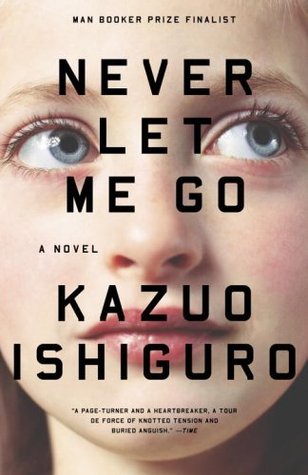
His sixth novel, “Never Let Me Go” (Knopf; 282 pages; $24), includes emotionally engaging passages about friendship, love, duty, sex and betrayal in the lives of the three main characters; however, the effect is undermined by the world in which Ishiguro contains them.
The story centers on Kathy, Ruth and Tommy, whose friendship begins at Hailsham, a boarding school in the English countryside.
Kathy is reflective, passive and somewhat dreamy. She is the kind of girl who, while listening to a pop song, dances and holds a pillow, pretending it’s her baby. Ruth is bossy and likes to appear knowing; it gives her a power that attracts others to her. For example, she pretends to know more about chess than the older students, but when she shows Kathy how to play, she says all the pieces move in an L-shape. Tommy is athletic, warm-hearted and gullible, and he is mercilessly teased by his classmates. The boys enjoy setting off his uncontrollable rages, and the girls like to watch from the dorm windows.
This post is part of Sci-Fi November, which you can read all about here.
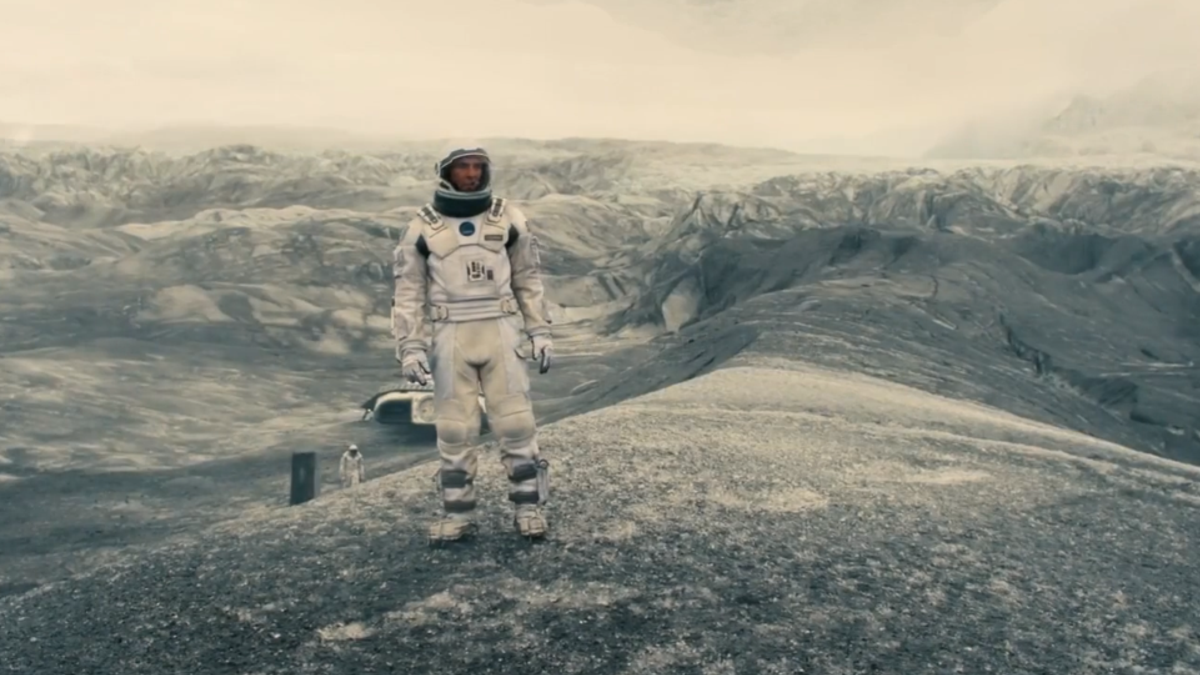
I haven’t seen “Interstellar” yet, but I have seen the teaser trailer, the official trailer, TV commercials and some feature stories in the NY Times, so I’ve been given an impression of the film and know it will have moments of sheer transcendental brilliance, and it will be an overlong, bloated slog that will leaving me feeling dissatisfied.
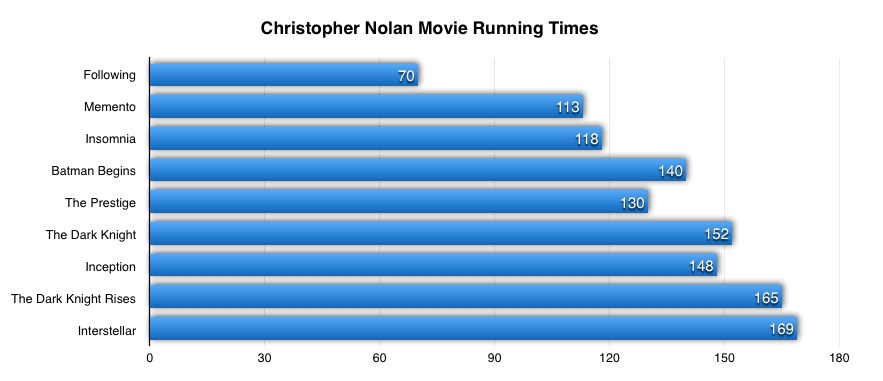
Here’s my Half-Baked Theory on Movies Directed by Christopher Nolan: the shorter the running time the greater the satisfaction.
Case in point: “The Dark Knight” (clocking in at 152 minutes was a thrill ride, until it had to go and not end and follow through with the Harvey Dent / Two Face story). Thus it ranks as one of his least satisfying movies. “The Dark Knight Rises,” which is 13 minutes longer, is proportionally more dissatisfying: so much great spectacle (Hines Ward running as the football field behind him collapses? Wow!) and then so many stupid fist fights – FIST FIGHTS!?!?
Of course, I just came up with that theory off the top of my head, but the lengths of Christopher Nolan’s movies aren’t something that I alone am interested in. Peter Sciretta over that the Slash Film website even created this chart (URL for the chart is here):
About me and Sci-Fi
You can read more about me here. My relationship to Sci-Fi goes way back, maybe all the way to the first book I remember reading, “Bears on Wheels” (does that count as Sci-Fi? Or is it sci-fantasy? Where do anthropomorphized animals exist within genre classifications if not Sci-Fi?). This is just my way of saying that, like many people, I was invested and interested in science fiction long before I knew the genre was called that. I consumed books, movies and TV shows that all fit within the genre. But I have my limits. I’m a big fan of the original series of Star Trek, but for some reason have never been able to get into Dr. Who. I really enjoyed reading Arthur C. Clarke’s 2001: A Space Odyssey (as well as 2010), but Kubrick’s movie always seems slow when it gets to space and bloated in the final third. Some of my all-time favorite books are set in post-apocalyptic zones (such as A Canticle for Liebowitz and the MaddAddam trilogy), and yet I’ve had a hard time getting into many of the post-apocalyptic TV shows like Defiance, Falling Skies, Jericho, and even, yes, BSG (though Walking Dead works for me).
What I’ll be doing this month
I plan on writing a handful of blog posts this month, including reviews of MaddAddam (thus completing a trilogy of reviews for the trilogy) and the movie Intersteller, and some posts that I hope will be provocative discussion starters about the relationship between science fiction and war, and about whether genre classifications are a necessary evil.
Most of the time, I will be reading what other bloggers’ contributions to the month. This, to me, is the best part, because so many of my fellow bloggers are new to me. So I’ll be searching Twitter for #RRSciFiMonth and reading and commenting on other blogs (this list of participants for Sci-Fi November is right here).
Thanks for reading, and please leave a comment to let me know you were here, even if all you want to say is “Hi!”