







 I love this book. Get it. Read it. Now.
“After Birth” by Elisa Albert tells the story of three months in one woman’s life around a year after giving birth who befriends a former “almost” rock star/poet who is about to give birth. The narrator says of the poet: “I’m a little obsessed with her, by which I mean a lot, which I guess is what obsessed means.”
In that sentence, Albert achieves the creation of a distinctive character in her narrator: a sharp sense of humor, somewhat confessional, somewhat striving for clarity, while also somewhat muddled. Ari, the narrator, may not always be a sympathetic character (one of the first things she does is call the upstate city she lives – a fictional town called Utrecht, but an easily readable blend of Albany, Troy, Schenectady — a “shitbox”), but her language is so seductive that it can charm the reader, even in her most negative moments.
After all, Ari seems to be suffering from a kind of post-partum depression, a severe disorientation in which she feels betrayed by a world that didn’t prepare her for life after having a child, she’s lost interest in completing her doctorate in women’s studies, she feels isolated in the aforementioned “shitbox” town, and all of it has been exacerbated by having undergone a c-section operation.
If that weren’t enough, there is also that special kind of existential dread a parent faces by bringing a new life into the world: “I’m not going to pretend my kid is special, like other kids who starve and freeze and get raped and beaten and have to work in factories and get cancer from the fumes, too bad, so sad, but my kid is going to be warm and organic and toxin-free and safe and have everything he wants when he wants it and go to a good college and all is right with the world! Fuck that myopic bullshit. He’s going to suffer. He’s going to get mauled by some force I can’t pretend I can predict. We all live in the same fucked-up world.”
(more…)


I didn’t see as many movies as I’d like this past month. Just two:
The Interview (2014)
Randall Park steals it,
Though it isn’t that funny.
— Too much James Franco
Frances Ha (2012)
A Gen-Y woman
In New York and then Paris
Grows up — a little
Read January’s haiku movie reviews here.

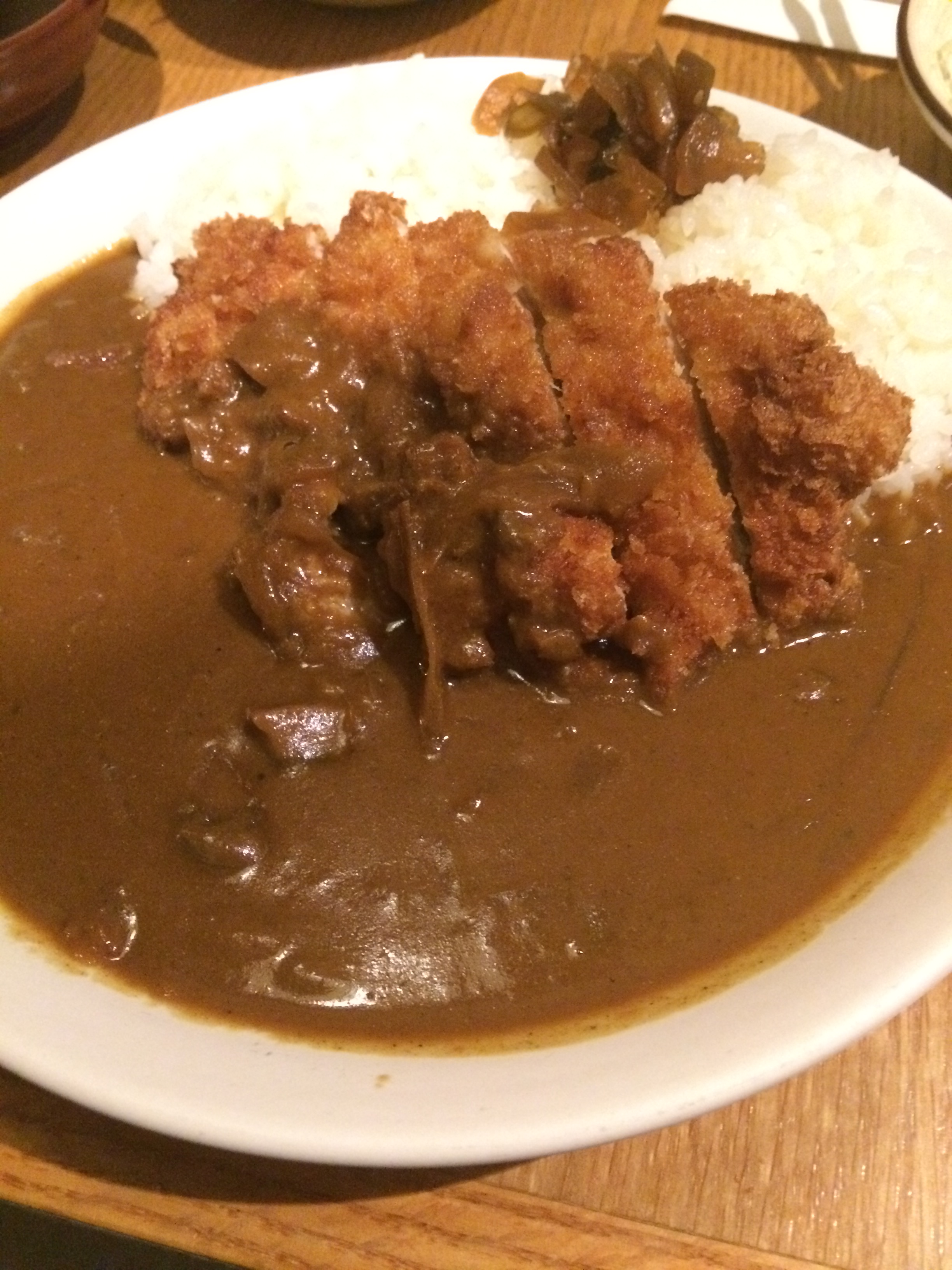
When I think of comfort food, this is one of the things I think of: Japanese curry tonkatsu. It’s somewhat spicy, savory, and crunchy, a pork-based meat-and-potatoes kind of dish (especially if the curry has potatoes in it) that is perfect for a winter dinner. This dish is usually served with shredded cabbage (which is in the bowl that is only partially visible in the upper right hand corner of the photograph).
When I lived in Tokyo, I ate a lot of curry tonkatsu. Only a few restaurants did it exactly the way I liked it (though even when it wasn’t great, it was still good). Lucky for me (though maybe not my waist) was that a restaurant that always had the right amount of crunch on the breaded pork, and the right amount of juiciness of the pork, and just the right amount of spice in the curry was a few doors down from my office in an area of Tokyo between Akasaka and Roppingi, not far from the ANA Hotel.
The cool thing about katsu-curry is that it is such a wonderful hybrid meal. Most people think “sushi” when they think of Japanese food, and not breaded, fried, pork cutlet. Ton, afterall, is the Japanese word for “pork,” while katsu is supposedly the Japanization of the English word “cutlet,” so that part of the meal is a Japanese-Western combo. Meanwhile, curries are more often association with South Asia, though supposedly for the Japanese, their version of curry came from India but via England.
A New York Times article from 2008 delves into the mystery and magic of katsu-curry:
“Indian curry came to Japan from England,” explained Hiroko Shimbo, the Japanese chef and cookbook author. “Roux of course came from France.” It was only natural that someone would put them in the same dish, she added, then paused for a moment and laughed. “It’s perfect for Americans,” she said. “It’s a very American impulse to mix.”
I really like that quote. After all, being an Asian-American hybrid myself, I always found myself feeling more and more American the longer I lived in Japan. (This may be true for many people living outside their home country: I was often put into the position of having to represent America with innocent-ish questions like “What do Americans like to eat?” In those situations, almost all my answers had some mention of how they can be so many different approaches to favorites based on heritage, family, friends, location, etc.)
Thing is, since moving back to the US now more than 20 years ago, I haven’t been able to find a katsu-curry that lives up to what I experience in Tokyo. Until now. The Katsu-Hama Restaurant in midtown Manhattan does the katsu-curry right. I recommend it.

This was a fun listen: “Prophecies, Libels and Dreams” by Ysabeau S. Wilce, which I got in a giveaway from Small Beer Press (Thank you, Small Beer Press!).
I didn’t know what to expect, and so this was my introduction to the fictional world of Califa that Wilce has written about in previous books, where there’s magic, magic boots, thieves, soldiers, deceptions, betrayals, and arranged marriages.
The best part of these interconnected stories is Wilce’s exuberant facility with language. Here’s a long example from the story “Quartermaster Returns”:
He died a hero’s death, Lieutenant Rucker did, trying to save, not another comrade, but rather the hog ranch’s entire supply of beer. The story is short and tragic: the freight train dropped fifteen cases of beer at the hog ranch, before proceeding on to Rancho Kuchamonga; an inexperienced drover off-loaded the beer in the arroyo below the hog ranch; when the storm came up, Pow organized his fellow whist players into a bottle brigade and supervised the shifting of fourteen cases to higher ground; the water was already foaming when Pow went back for the last case—refusing to allow the others to join him in harm’s way; Pow heroically managed to shove that case up the bank, just as a wall of water twenty feet high came roaring down the ravine.
This minitale is a great example of the kind of tall tales that dominate the seven stories in this collection. And these stories are offset by short “corrections” in the guise of an academic critique, often decrying the inexactitude of the previous tale. It’s a nice movement to add this layer to deepen a sense of place and time.
An unfortunate aspect of this audiobook is that the first story, which may be the whimsical, elicits from the reader some of the most forced interpreations that make him sound actorly in a too-forced storybook way. The audiobook does get better though.


Internal Affairs (1990)
Cop flick from long ago
It probably felt dated
When it was released
3 Days to Kill (2014)
A dad and killer
Bossed around by a hot chick
Dumb but fun action
Alex Cross (2012)
Guy from “Lost”? Creepy
Tyler Perry – he can act!
So where’s the sequel?
Strange Days (1995)
Before Y2K
Cops, murder, rape, data discs
A fine mess for Fiennes
Pride (2014)
Gays support miners
In Thatcher’s beastly Britain
Wonderful friendships
Selma (2014)
Protests need clear goals,
Strategies, tactics, leaders
— True courage routs hate
Kon-tiki (2012)
Thor sets out to prove
Islanders came from Peru
— all on one big raft
Saving Mr. Banks (2013)
Disney wants Poppins
The author has a conflict
With her long dead dad
Boyhood (2014)
Here’s a crushing truth
“I just thought there would be more”
as time marches on
Here’s a view of a beach in Maine from August 2014 as a reminder that winter’s do end.
You’re welcome.
 I quit a book the other day.
I’ve seen Harlan Coben books everywhere, but I had never looked at one. At the library, I picked up the audiobook version of “Six Years,” read by Scott Brick (who I think has done a great job with Justin Cronin’s “The Passage” and “The Twelve”).
I only made it through the first disc.
The novel’s title “Six Years” refers to the length of time from when the narrator, Jake, attends his ex-lover’s wedding to when he reads of her husband’s death (and attends the funeral). He reads the obituary, and then he attends the funeral and is surprised to find out that the dead husband was a doctor, had a teenage son, and his wife was some other woman instead of Jake’s ex-lover.
Here’s the problem: those facts (that he was a doctor, his wife’s name being different from the name of his ex-lover) are all things that should’ve been part of the obituary. Sure, I’ve worked in journalism for many years, and maybe that gives me a specialist’s knowledge about how a professional would write an obituary. Though I’m pretty sure most people would expect that kind of information. So it made me not trust this book. After all, Jake’s surprise – his need to get to the truth of the matter – seems to be the main engine of the book. But because it required him to go to this funeral, even though the obituary should’ve given him the same surprising information, the contrivance of the plot revealed itself too me far too readily.
Have you quit a book because the author tried, and failed, to use something in your area of expertise?
