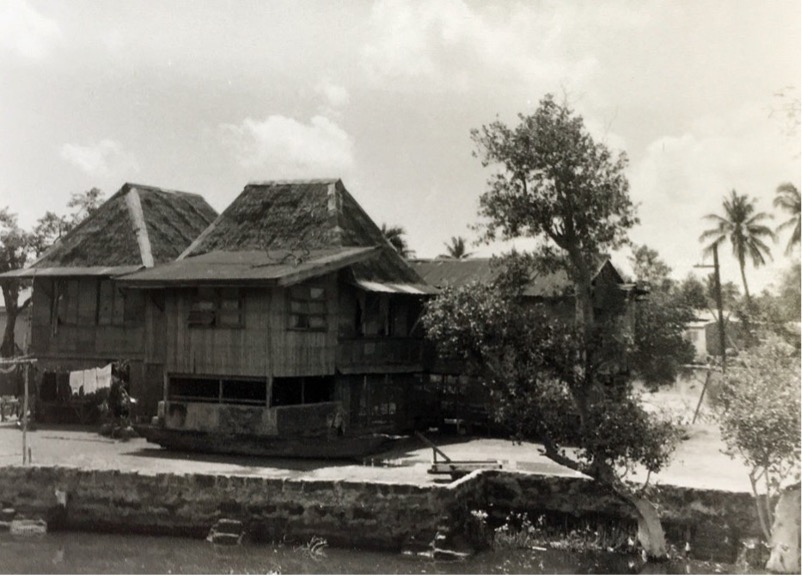
This poem was originally published in the inaugural issue of the now-defunct Canadian publication re:asian magazine on May 30, 2017. The publication included the photo above of the home where my lolo — grandfather — grew up.
The mission of the United States is one of benevolent assimilation
— President William McKinley, December 21, 1898

My first flight to Manila slammed turbulence and dropped,
wire tangles and oxygen masks falling from consoles
as fellow passengers shrieked in horror and murmured
prayers and worried rosary beads as still we fell

Beside me, a mop-haired student white-knuckled his armrest
and refused one of the bottles of water left in my lap
by a harried flight attendant rushing to his jump seat
as still we fell and he asked: Aren’t you afraid?

Something like fear structured my feelings around the word Philippines and whatever it was that connected me to it
and inspired a grade-school history project and devouring Philippine history from the American, the victor’s, point of view,

a view I knew also to be mine and not mine at the same time,
an auburn-haired traveler with freckles and food- and music-loving tendencies that others had said defined a kind of Filipino,
not that I could share all this with my seat mate.

What daunting shame enveloped me in U.S. history,
from the Declaration’s heights of human liberty,
and the Constitution’s rights of the citizenry to stumble
upon McKinley’s twisted view that shaped my destiny.

My report lacked room for history’s trajectory
that led me to be a First American Born mestizo
but I could report on the facts of U.S. diplomatic duplicity of a deal to thwart Aguinaldo’s rebellious tendencies.

So structures, not fate, crafted in the benevolent guise
of American supremacy, a Democratic-loving vassal
of the Empire of hypocrisy that defines all American histories, traced in twisted terms in eminent proclamations.

The flight steadied, course corrected, and my seat mate,
prayers answered, cheered when wheels touched ground,
while I, pale and exhausted, shuffled onto ancestral ground,
feeling familiarly unsettled, a homecoming, not home.
Michael Janairo’s family name, pronounced ha-NIGH-row, is listed in the Catálogo alfabético de apellidos, which was created in 1849 by the Spanish colonial government to give surnames to Filipino subjects who lacked them. His Filipino father and American mother met in Germany; he was born in Iowa. His writing has been published in or is forthcoming from Lontar #8, Mithila Review, World Haiku Review, The Ekphrastic Review, Long Hidden anthology, Eye to the Telescope, Kartika Review,Walang Hiya anthology, and Maganda Magazine, among others. He lives and works in upstate New York and blogs at http://michaeljanairo.com.

 As President Bush tries to shape his legacy in regards to the Iraq war, he should pick up David Silbey’s engaging history “A War of Frontier and Empire: The Philippine-American War, 1899-1902” (Hill and Wang; 272 pages; $26).
