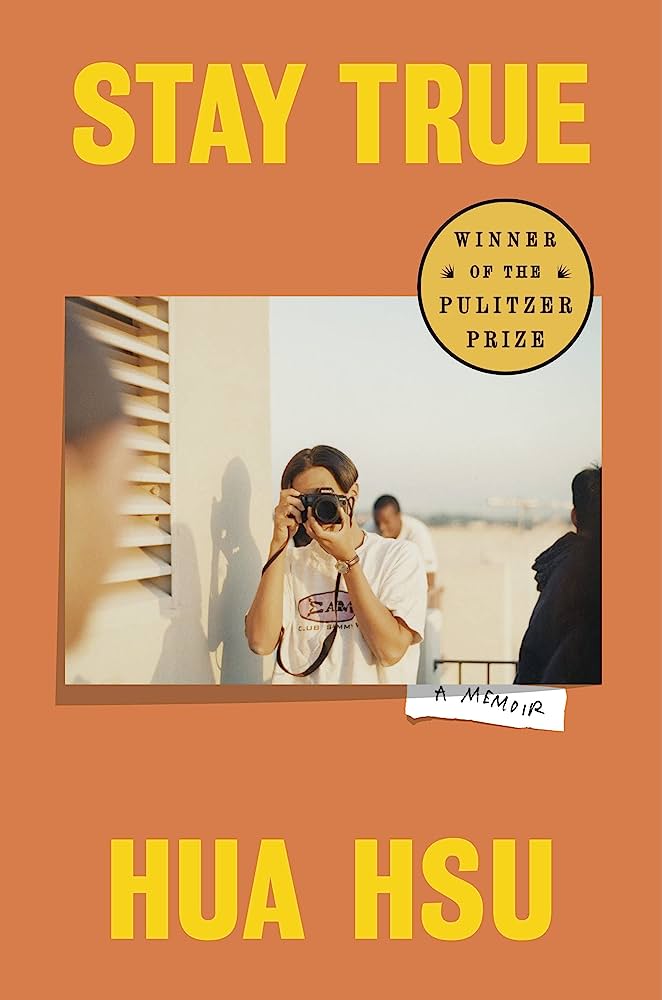
Last summer, I was asked to write a response to Hua Hsu’s memoir Stay True as part of Skidmore College’s First-Year Experience summer reading program. I’ve been thinking about it since, especially how the questions it raises about Asian American identity remain unresolved. This is what I wrote.
Hua Hsu’s moving memoir “Stay True” raises important questions about identity formation: Who shapes us? Our parents? Our friends? Ourselves? Strangers?
“I defined who I was by what I rejected” (p. 27), Hsu writes, speaking of music, films, books, and people—including Ken, at first. Rejection is often one of the first acts of identity assertion: think of a toddler yelling, “No!” Hsu’s unexpected friendship with Ken can be read, in part, as Hsu recognizing that, perhaps, taste is superficial.
What brings Hsu and Ken closer? Perhaps it’s their shared Asian-ness. They both feel distance from their parents. Hsu, whose parents are from Taiwan, even recognizes that Ken, whose Japanese American family has been in the U.S. for generations, has a stronger claim on America. But he also suggests that the white-dominant culture of the U.S. doesn’t offer them clear futures when he writes of their friendship: “Who needed role models when we had one another?” (p 191).
I think you can read their creation of Barry Gordy’s “IMBROGLIO” as their attempt to write themselves into being. Such an assertion of identity, though, creates tension with the dominant culture. Perhaps negotiating that tension is what it means to be Asian in the U.S.?
That rings true to me. I was always filled with anxiety on the first day of class in school and college. A teacher or professor would stumble over my family name, Janairo, pronounced ha-NIGH-row, and put an unwanted spotlight on me.
As the son of a Filipino immigrant father and an Irish American mother, I can pass as white. I could accept the mispronunciation and say, “Here!” But I like being Irish Filipino American. I want to respect my family name, my history. So I always give the correct pronunciation and, anticipating a question, say where my father is from and, then, anticipating another question, mention my mother’s heritage. This often makes me an object of fascination (“That’s so interesting!”) or suspicion (“Are you kidding?”).
A moment in “Stay True” hit me as especially poignant. In a rhetoric seminar discussion on race, Ken finds students dividing themselves between Black and white, while he “was hardly seen at all” (p. 78). That moment epitomizes how superficial—how skin deep—the concept of race is. Ken doesn’t fit the Black-white binary, so he isn’t seen; I, with white skin, claim a Filipino-ness, so I become a curiosity.
So how do we assert our identities?
There’s a nihilistic answer in Ken’s horrific murder. It suggests that, despite all of his brilliance and fun—his recognition of Hsu!—powerful forms of cruelty exist that don’t care and can take it all away.
A much more positive answer is the fact the memoir itself now exists. All its remembrances and illuminations of the Asian American experience, especially the complexities within those experiences, show the real power of sharing our stories to open up new understandings of our world, even long after a key player is gone.

