“So I’m thinking it’s either a Pulitzer in six years, or a mental hospital for you.”
That was Bob McClory, a journalism professor of mine who died last Friday at age 82. Or at least that’s what I remember him saying at the end-of-the-quarter meeting about my writing and final grade when I was a journalism undergrad student at Medill at Northwestern.
He thought my continual use of quotation ledes ventured onto the less sane side of decision-making. What I heard though in that sentence was: I see what you’re doing. I don’t always get it or agree with you, but I believe in you. He probably said the same thing to lots of other students. (more…)
A young person I know recently said something along the lines that Twitter was going down the drain. I don’t where that idea came from. I’ve been using Twitter since Sept. 19, 2008. (which is longer than 99.755% of all other Twitter users, according to http://twopcharts.com/howlongontwitter).
Perhaps the young person was thinking of sponsored contents like the ad here from the Alliance for Quality Education of New York. I ignore most Twitter ads but this one got me because of the words “ET HE UGLY RUTH.” (more…)
The first thing that caught my eye at the gas pump the other day as the phrase “Free meat,” right there on the upper right of this sign. As gas fumes swirled in the cold air around me, which was tinged with the taste of the rock salt that covers roads, tires and car bodies, I couldn’t help but think that nothing sounded less appetizing than the desperation of a phrase like “free meat.”
Of course, that wasn’t the end of the line, but in my years as a headline writer I’ve come to respect linebreaks in a way a poet can understand. That the end of a line is an occasion for meaning. So I focused on “free meat,” before I realized that what the sign was really talking about was “free meat sauce” to go on the hot dogs, as well as “fixin’s.” So though the apostrophe may be correct as a way to signify a dropped letter, in this case a “g,” it also has the unintended consequence of making the word seem like it is a possessive (as in these signs).
Then I saw the hotdogs. Are they supposed to be cute and charming, dressed like chefs about to cook themselves? Is that why their smiles seem so forced, their eyes seemed to be crossed (as if to suggest lack of intelligence?), and the dog on the left is giving the finger? Are these subversive hot dogs?
Anyway: As I finished filling the tank, I was happy for this momentary distraction. It’s a lot better than the pumps that have the screens and the volume blaring at you. All I could think was that someone nearby was sitting at a desk and designed that thing, and someone else approved of it.
NOTE:If you are a fan of Person of Interest and haven’t seen Season 4 Episode 15 don’t read this because it is probably full of spoilers. It also contains wild speculation that probably has nothing whatsoever to do with the ongoing narrative of the show.
Here’s the IMDb description of “Person of Interest” Season 4 Episode 15, “Q&A”: “Reese tries to protect a software programmer with a mysterious second life, but it’s unclear which side of her life the threat is coming from. Meanwhile, Claire, a young hacker that Finch protected, reaches out to him for aid.”
Though “Person of Interest” has been praised as “powerful political science fiction” by i09, I was watching it to see artwork by my spouse, Deborah Zlotsky.
So in the show, her paintings were used as set decoration for a fictional software company in which much of the main plotline (about the programmer with a mysterious second life) is set. Though most viewers probably wouldn’t pay all that much attention to the artwork hanging in the background, it was what I was looking for — and the use of the work reveals a strange hidden narrative about one of the workers in the software company.
A scene from “Person of Interest” Season 4 Episode 15 “Q&A”
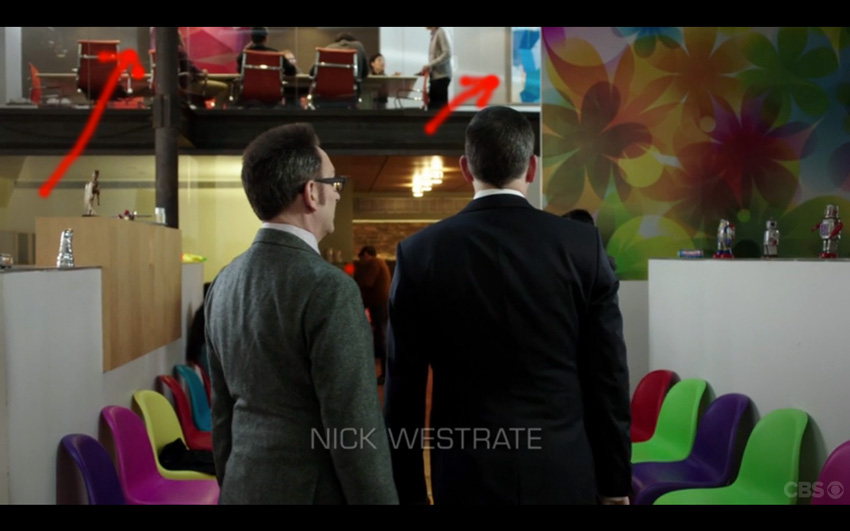
Here’s Finch (Michael Emerson) and Reese (Jim Caviezel) in an early scene of the episode. Up there in back, in what looks like a conference room, are two paintings. The one the left is one called Everything Must Go; the one on the right is called Not so happy, yet happier. Yes, my wife’s paintings are abstract, colorful, and with geometric and biomorphic forms. If you compare what you can see of the paintings in this screengrab from the show, though, with how they are presented here on my wife’s website and here on my wife’s gallery’s website, you’ll see the paintings aren’t hung as intended.
A scene from “Person of Interest” Season 4 Episode 15 “Q&A”
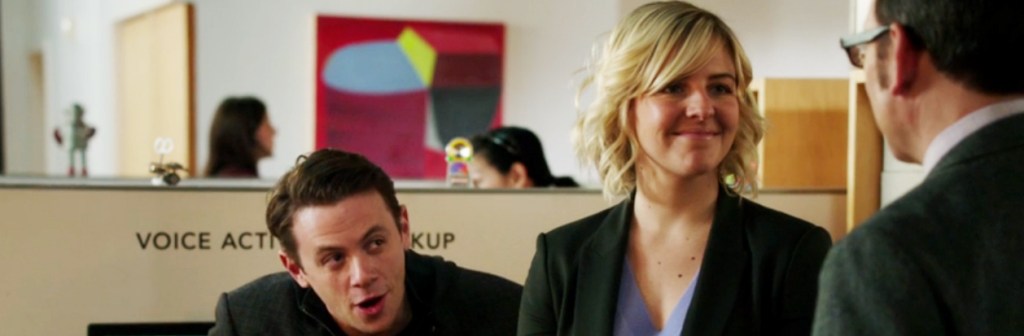
This painting, shown during the beginning of the show as the credits are still coming onscreen, is called Situational, three, and can be seen better here. The clear view of this painting was a surprise, because I imagined that the paintings would’ve been used as they are in the first image (way in the background), or how they are used in the one below (just behind a closeup of a character so as to be unrecognizable). Keep Situational, three in mind: It will appear again. Plot bit: The guy (played by Nick Westrate) is the founder of the software company; the woman (played by Heléne Yorke) is the CEO.
A scene from “Person of Interest” Season 4 Episode 15 “Q&A”
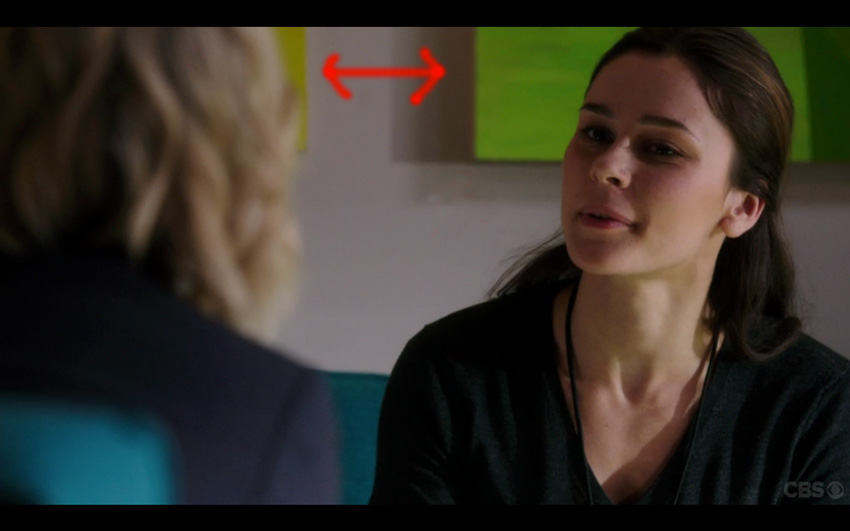
OK, not much to see here by way of paintings. I show this because this is how I imagined the paintings would’ve been used. Some story plot here: This image shows the programmer with a secret life (played by Bella Dayne) being scolded by her boss (the CEO) for looking into something a co-worker told her to forget about.
A scene from “Person of Interest” Season 4 Episode 15 “Q&A”
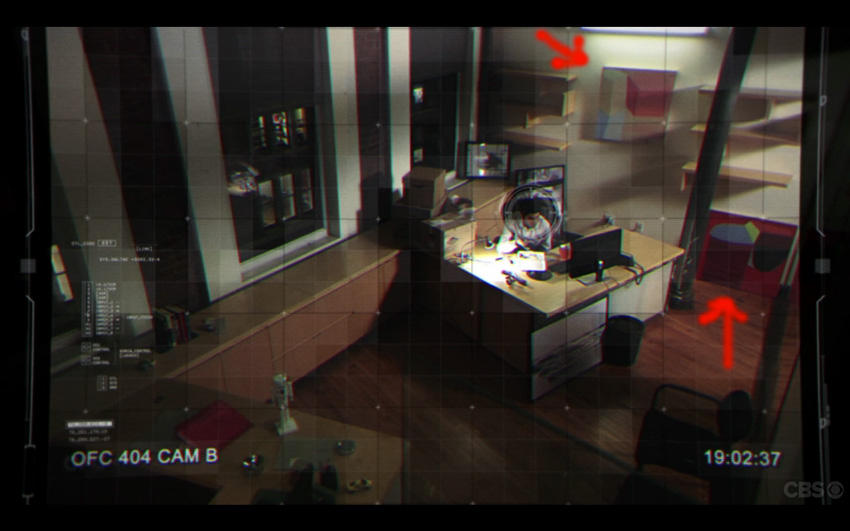
Another plot point: This is the new office of the co-worker who told the programmer to forget about something. He’s gotten a promotion. That means he’s moved out of the open office area (which was presided over by Situational, three) and into his own office. Note, moving into his own office space means he gets two of my wife’s paintings: The one hanging on the wall is called Situational, one, and a closer look at it is available here; the one one the floor is, yes, the previously seen Situational, three. The show doesn’t explain why that painting, which was previously looking over the open-office area, gets to be used by one employee in his own office. I can think of two reasons: The set directors wanted to imply a hidden narrative that this worker in addition to getting his own office also gets to have this cool work of art in his office, not only as decoration but also as a reminder of where he had come from. OR, maybe, the set directors didn’t think anyone would notice.
A scene from “Person of Interest” Season 4 Episode 15 “Q&A”
Here’s a closer look at Situational, one and the actor Omar Maskati, in the role of the guy who got the promotion. This painting, too, will show up again later.
A scene from “Person of Interest” Season 4 Episode 15 “Q&A”
This is my favorite screenshot. Here’s the programmer with the secret life (she’s an underground mixed-martial-arts fighter in her spare time to help pay for her sister’s chemotherapy, of course) in a fight with some bad guys in her CEO’s office. Yes, those are the paintings that were only visible as small rectangles of color in the earlier close-up photo of Bella Dayne. The painting on the left is Situational, two, and the painting on the right is Situational, four. Why is this fight happening? It has something to do with the software company’s founder being a bad guy with henchmen, unbeknownst to the programmer or even the CEO. But did the guy who got the promotion know about it?
A scene from “Person of Interest” Season 4 Episode 15 “Q&A”
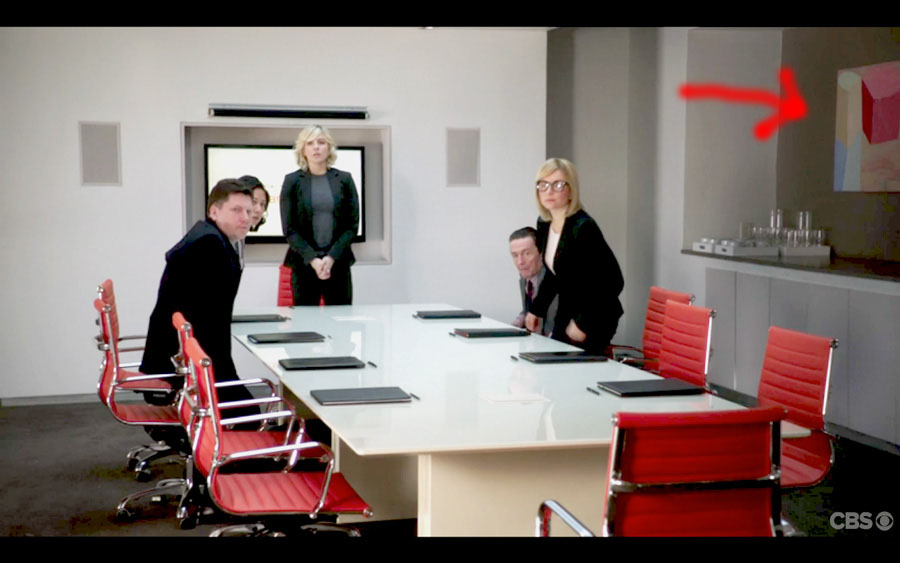
This image is from the final scene of the episode. Gone, now, is the founder (for being a bad guy), so the CEO is in the boardroom in charge of everything. Absent from the room is the guy who got the promotion. On the wall at right, however, is the painting Situational, one that had been in that guy’s new office. What’s happening here now? It seemed like the whole guy getting the promotion was just a red herring, and that the real bad guy was the founder. So what happened to the character that he’d lose the painting in his office? Even more so, this is a conference room, and yet in one of the first scenes there was a conference room that had two different paintings. If you look at this photo here and the first photo above, you’ll see that both conference rooms feature the same kind of red chairs. Could this be the SAME conference room?
If it is the same conference room, then I think I’ve uncovered a hidden narrative about this episode having to do with the company and my wife’s paintings. In this software company, it isn’t just people that get promotions, but paintings get promotions, too. As one moved from the open office into a private office, another moved from a private office into the more visible conference room (and replacing one painting). So the question I’m left with is: What happened to the painting Everything Must Go, which was visible in the first photo but has been replaced by Situational, one in this photo? Is this another mystery for “Person of Interest?” Perhaps its the opening for a spinoff show: “Painting of Interest?” (Or, maybe, I’m reading too much into it, and the makers of the show didn’t think anyone would notice.)
For your enjoyment, two videos about the Philippine-born, NYC-based artist Paul Pfeiffer. He’s represented by Paula Cooper Gallery in NYC. Of interest to me is his exploration of images of basketball, especially considering the long history of basketball in the Philippines. (A quick history of it can be found here.)
As part of the U.S.’s colonial policies of “benevolent assimilation” in the Philippines, they set up a system of universal education. At first, the primers were geared toward U.S. children (with references to things outside of most Filipino experiences such as snow), and then new primers were made.
This page comes from a 1908 Revised Edition of the First Primary Language Book by O.S. Reimold.
This is the entirety of the essay and image to go with lesson 40 (what follows it are a description of centavos and pesos, and then “Written Exercises” such as “Write the names of ten things that you can buy in the market.”).
The questions the passage raises for me are: Who is the we? Is it the teacher (whether a Filipino or American) and the school children in the moment of the lesson? Or maybe I’m reading the “We” all wrong, and perhaps it refers to all the members of the colonial system? After all, wouldn’t it be too much to expect school children to have spending money for the market? So then is the “We” supposed to be a generalized “everyone,” as in “everyone goes to the market”? Then again, the “we” seems to be in opposition to the “many people” in the previous sentence? Couldn’t it be possible that some of the Filipino children learning to read, speak and write in English through this lesson be part of the “many people”? Is there a class distinction at play here that may be confusing to some of the student? Doesn’t the act of naming the shopper (Natalia) as opposed to the seller (“the man”) further that kind of class difference? And then, if the narrator can name one of the people depicted in the image, how is a child supposed to respond to those final questions about who is buying and selling the chicken? Are children supposed to know the names of the people? Are they supposed to respond with a gender identification (“the woman”/”the man”)?
Yan Lei Landing-Shanghai, 2007, at Tang Contemporary Art, BeijingThomas Huber, vis-a-vis, at Galerie SkopiaMilton Avery, 1951Sarah Cain at Galerie LelongGlenn Kaino, A Shout Within a Storm, 2014, at Honor Fraser
“After Birth” by Elisa Albert tells the story of three months in one woman’s life around a year after giving birth who befriends a former “almost” rock star/poet who is about to give birth. The narrator says of the poet: “I’m a little obsessed with her, by which I mean a lot, which I guess is what obsessed means.”
In that sentence, Albert achieves the creation of a distinctive character in her narrator: a sharp sense of humor, somewhat confessional, somewhat striving for clarity, while also somewhat muddled. Ari, the narrator, may not always be a sympathetic character (one of the first things she does is call the upstate city she lives – a fictional town called Utrecht, but an easily readable blend of Albany, Troy, Schenectady — a “shitbox”), but her language is so seductive that it can charm the reader, even in her most negative moments.
After all, Ari seems to be suffering from a kind of post-partum depression, a severe disorientation in which she feels betrayed by a world that didn’t prepare her for life after having a child, she’s lost interest in completing her doctorate in women’s studies, she feels isolated in the aforementioned “shitbox” town, and all of it has been exacerbated by having undergone a c-section operation.
If that weren’t enough, there is also that special kind of existential dread a parent faces by bringing a new life into the world: “I’m not going to pretend my kid is special, like other kids who starve and freeze and get raped and beaten and have to work in factories and get cancer from the fumes, too bad, so sad, but my kid is going to be warm and organic and toxin-free and safe and have everything he wants when he wants it and go to a good college and all is right with the world! Fuck that myopic bullshit. He’s going to suffer. He’s going to get mauled by some force I can’t pretend I can predict. We all live in the same fucked-up world.” (more…)














 I love this book. Get it. Read it. Now.