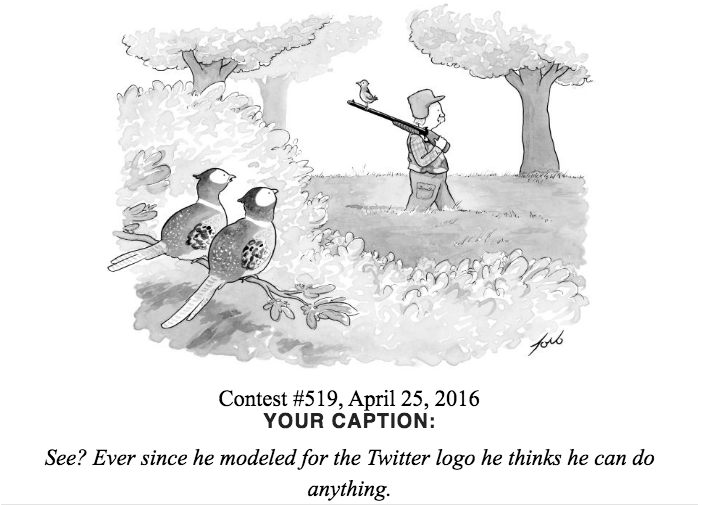
My entry: New Yorker cartoon contest #519

Screen Shot 2016-04-23 at 3.23.24 PM

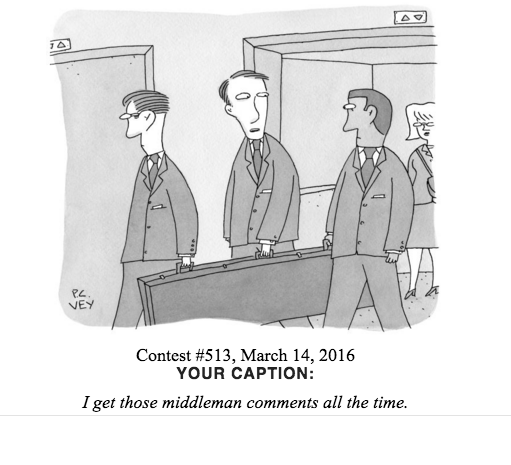
My entry: New Yorker cartoon contest #513

Screen Shot 2016-03-13 at 4.30.07 PM

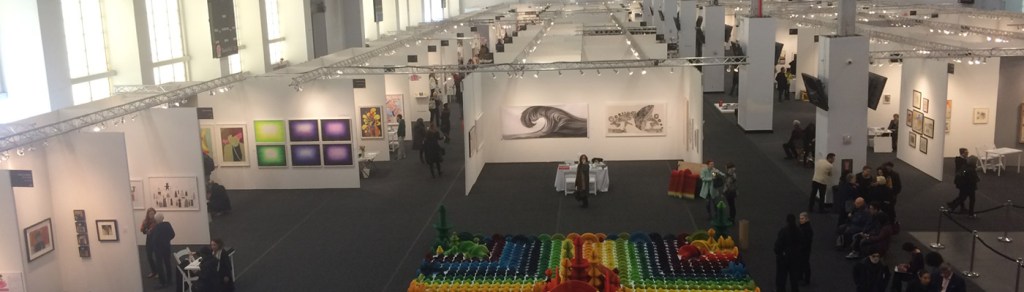
Highlights from Art on Paper, a NYC art fair

For the past few years, the New York City art fairs have become part of my day job. This year, for the first time, I visited Art on Paper.

Here are some highlights:
tillinghast1

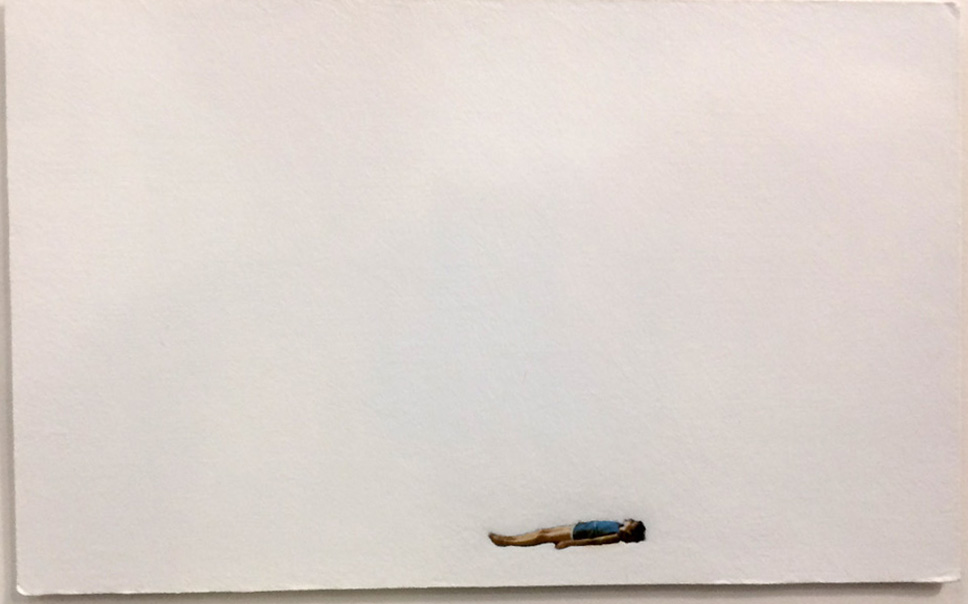
Eric Tillinghast, Aegle, 2014, was exhibited among other similar work at the Richard Levy Gallery’s booth. Tillinghast’s work features postcards of swimming pools and other bodies of water in which most of the context has been painted out. Here, for example, a figure that could’ve been reclining poolside now appears to float in a surreal white space, detached from anything familiar.
 

semmes1

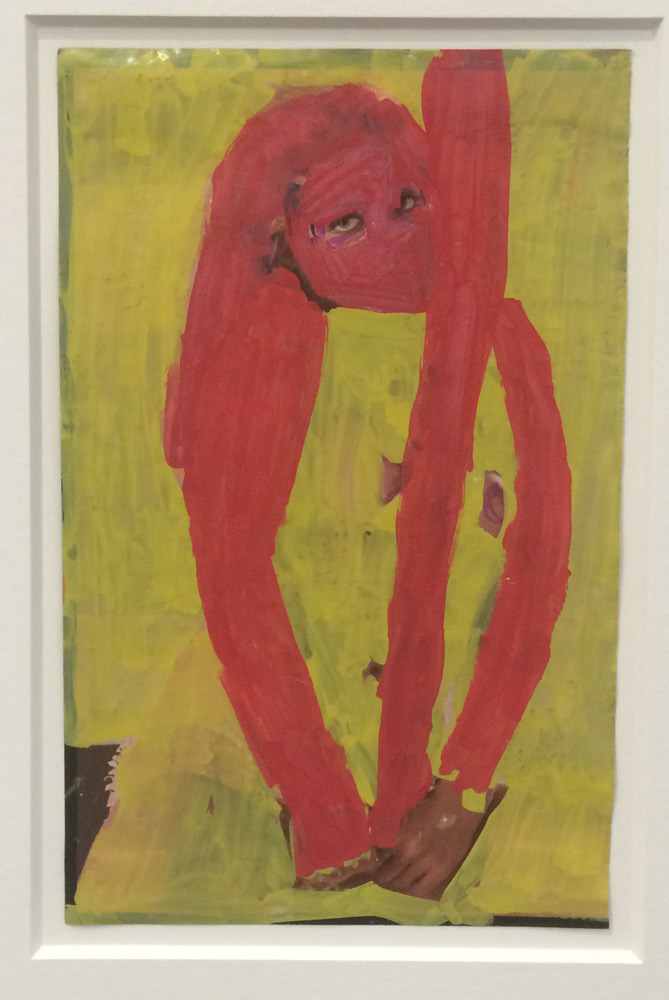
In a somewhat familiar vein is this piece by Beverly Semmes, shown at the Shoshana Wayne Gallery booth. Here, the decontextualization through paint over a found image is a covering up of a female body that had been in a pornographic magazine. I’m familiar with her work from the Tang Teaching Museum exhibition that included similar painted-over pornographic images. This work is part of a group of work Semmes calls the Feminist Responsibility Project, as if it is her responsibility to cover up these nude women. Though some younger women, Skidmore students, wondered how did Semmes know if these women weren’t being responsible and in control of how their images are being taken and how they are being compensated for them?
grillo1

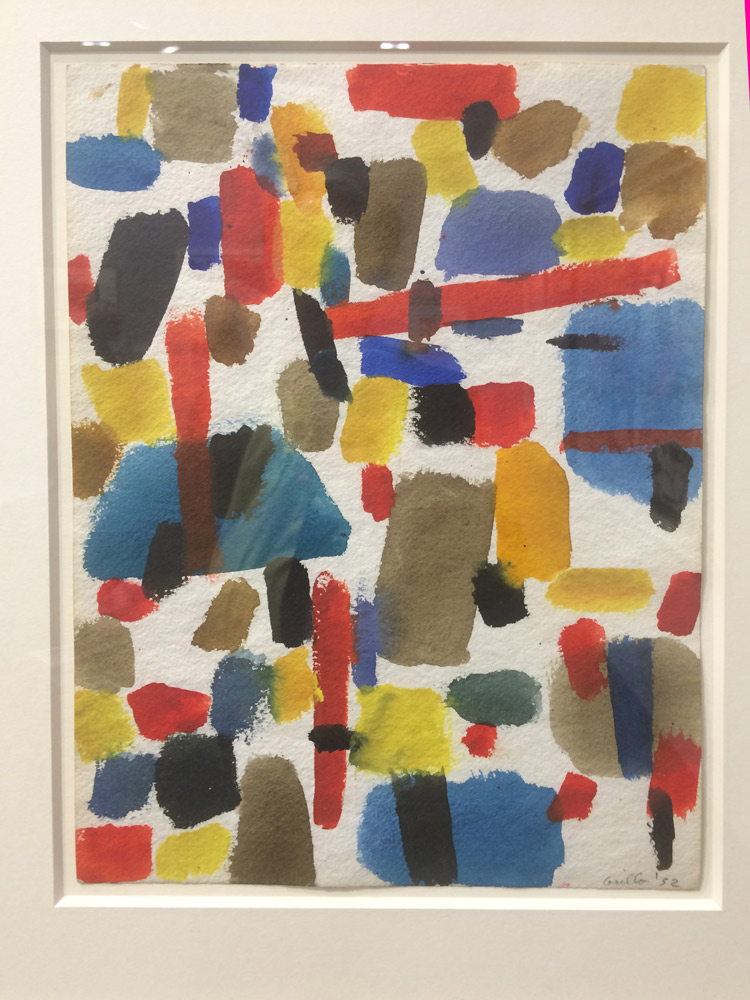
John Grillo’s Untitled Mosaic 5, from 1952, was on view at the David Findlay Jr Gallery booth. This work looked like something from the 1950s, but the mosaic pattern reminded me of the work of Alma Thomas (though her oils feel weightier and more satisfying). I enjoyed the exuberance of it, though that is offset by the watercolor’s delicacy.
freeman1

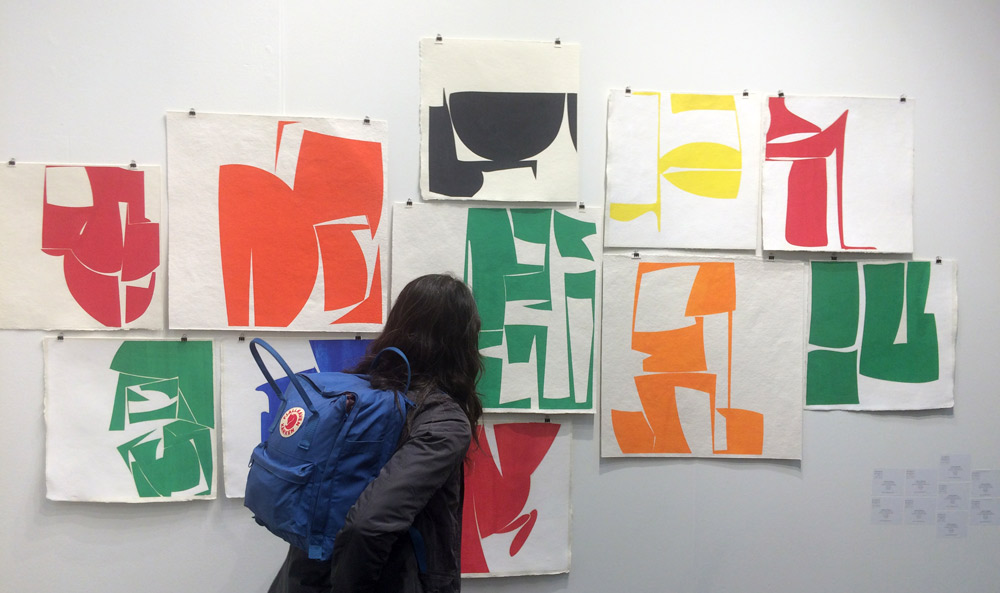
Speaking of exuberance, I really enjoyed this display of Joanne Freeman’s recent work, goache on handmade paper on view at the Kathryn Markel Fine Arts booth. There’s something playful in the geometric shapes, how some crowd the edges of the work, and others open to the paper behind it, as if defining a new kind of alphabet, or a new kind of geometric language.
DaveEggersAonP

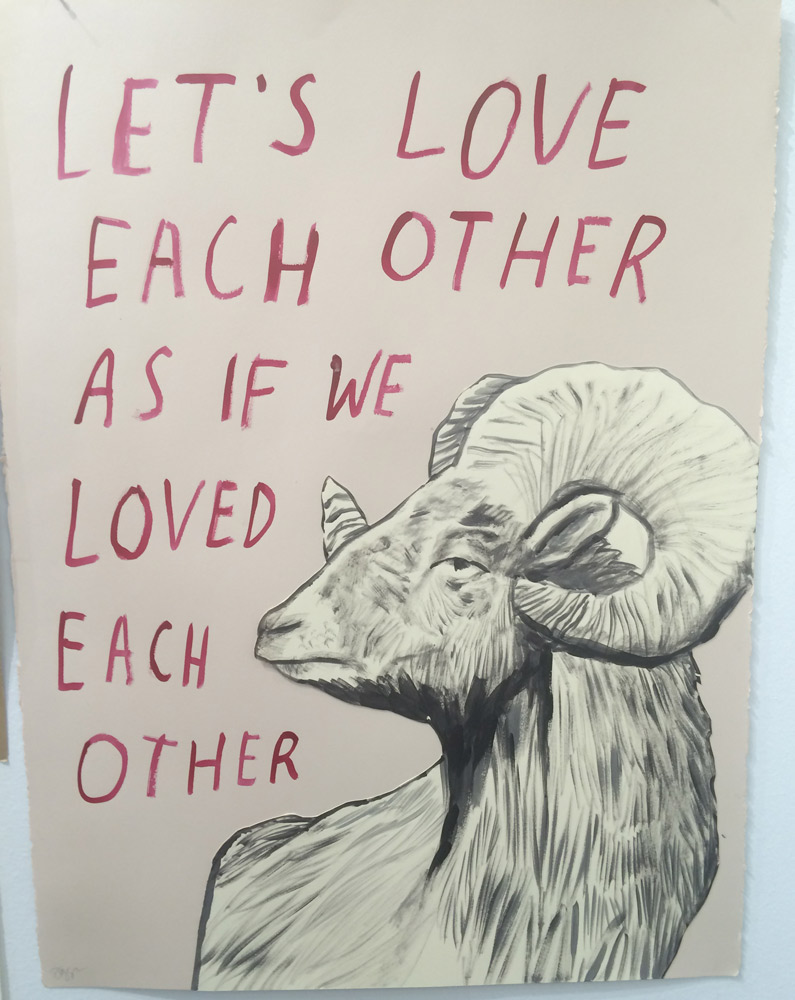
And then I came to this, by the multitalented author-artist-publisher Dave Eggers, at the Electric Works booth. This work — being exhibited for the first time — was fun and unexpected, playful, silly, and poignant. Plenty more examples of his work can be found here. Dave Eggers being Dave Eggers, the proceeds from the sale of his works were all to go to ScholarMatch, a nonprofit he founded that connects donors with students who need help paying for college.

Having attended other art fairs before, I really enjoyed Art on Paper — it was smaller than others, so it felt easier to get around and less crowded. Plus the work itself felt smaller, sometimes more intimate, and therefore more accessible.

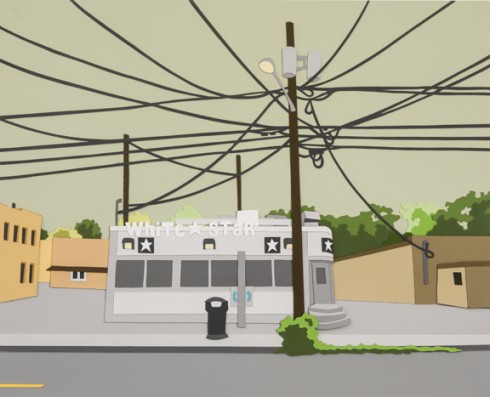
Though one of the most memorable shows of work on paper was something that I didn’t see at Art on Paper; rather, it was the work by Casey Ruble on view at the Foley Gallery in the Lower East Side. The work features cut paper that is layered to produce landscapes, cityscapes and interiors.
theysaidthey1

Here is “They said they’d rather die here than in Vietnam.”, 2015, which is only 6.5 x 8 inches. This reproduced image of the paper collage doesn’t do justice to the cuts and layering, which are visible upon close inspection of the real thing. That’s one of the things that makes seeing the object in real life so much  more rewarding, and the work so much more powerful.
 

Why you should download the massive, free e-book ‘Up and Coming’

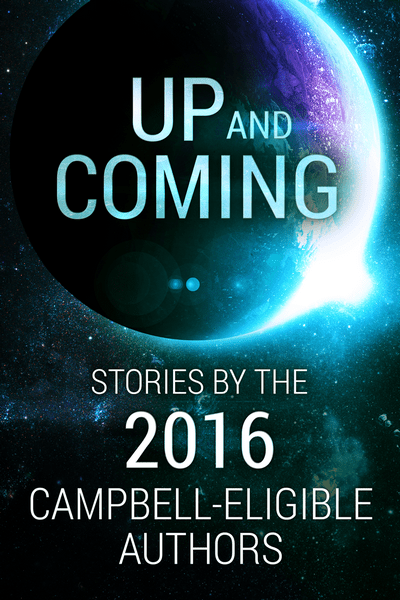
AnthoCover3_400.pngWhat is the future of science fiction?

It could be in the pages of Up and Coming: Stories by the 2016 Campbell Eligible Authors.

You can download the book here: http://www.badmenagerie.com/

Hurry up, though, the download will only be available until March 31, 2016.

What is a “Campbell Eligible Author” you may ask? These are writers who are new to the science fiction and fantasy field with their first professionally paid publications. The John W. Campbell Award is presented at the World Science Fiction Convention (this year, it will be held in Kansas City, Mo., in August). More info on the awards is available here: http://www.writertopia.com/awards/campbell

I was happy to see lots of writers that are familiar to me from my reading of shot stories and/or SFF-related blogs, including:

  • Nicolette Barischoff
  • S.B. Divya
  • David J́on Fuller
  • Jaymee Goh
  • LS Johnson
  • Alyssa Wong
  • Jeff Xilon
  • Isabel Yap

So you could consider this list of writers as a point of entry into this tome. You may find plenty of your gems in it, though.

Let me know what you find and recommend.


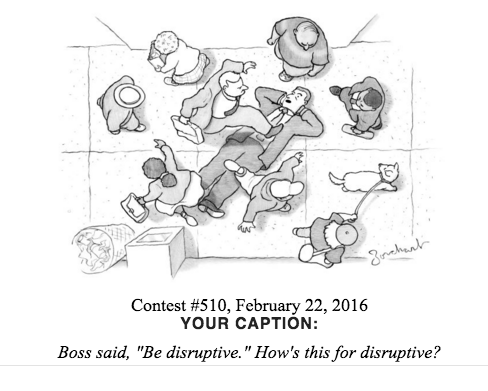
My entry: New Yorker cartoon contest #510

Screen Shot 2016-02-20 at 2.58.21 PM

Submittable and the neurotic writer

As many writers know, there are all sorts of way submissions of stories and poems to journals and magazines get submitted. Few places take postal mail. Lots of places take email. Most, though, take neither and use some kind of online form, such as Submission Manager, or Submittable.

Screen Shot 2016-02-27 at 12.27.34 PMHere’s the thing about a service like Submittable: You get to see whatever you have out in the world awaiting a judgment in one fell swoop.

Once a piece of writing has been submitted, the first status you see is “Received.” This status brings  writers a glorious sense of satisfaction, accomplishment and peace — for all of about 10 seconds. Then, as the days, weeks, and months (yes months) crawl by, and that status “Received” keeps saying “Received,” the writer begins to wonder, “Why are they ignoring me?” or “How can they let my work just sit there?” All a writer wants is a chance and some acknowledgment. “Received” comes to mean more than being ignored; it means you don’t have a chance (yet) and you aren’t being acknowledged (yet). “Received” can be very frustrating.

It should get better when a status changes to “In-Progress.” The first sight of it does produce of frisson of excitement — someone’s reading me! However, that can be quickly replaced with a sense of dread — someone’s reading me!

That second feeling persists, though, as the status remains “In-Progress.”

What happens next may not seem fair, or wonderfully fair. If the writing is “Accepted” or “Declined” (or if it is “Withdrawn” by the author) that status doesn’t appear — at least if the writer is looking only at the submissions that are still “active.” Of course,  you could switch tabs and look only at the “Accepted” writing — and if there’s a new one, the one that had just disappeared from the “active” list, then much celebration can ensue. Or you could look at the “Declined” list, and, if the new one is there, instead, I suppose the opposite of much celebration will then ensue.

No matter what, though, Submittable is supposed to make tracking writing submissions easier — and it removes what in the pre-Internet days was just months of months of not knowing until a SASE returned. Now there are statuses that can appear frozen in place for months and months, and each one can fill a writer with various levels of anxiety and dread.


Fun with numbers, primary-election style

As the primaries continue, I was wondering about turnout. Everyone says turnout is so important. Is there a connection between primary turnout and general election turnout? And how many people have the early voting states turned out?

I wanted numbers:

From the Des Moines Register on the Iowa caucuses:

Republicans counted more than 180,000 caucusgoers, topping their 2012 attendance record of 121,503 by an estimated 60,000 people.

But they didn’t have the Democratic Party numbers. I found those on Bustle.com:

Many precincts were delayed in reporting the Democratic results, but early Tuesday morning, the Iowa Democratic Party announced that171,109 Iowans participated in its caucuses. That’s a fall from 2008, which saw 239,000 vote in the Democratic caucuses throughout the state.

For New Hampshire, I found this from the Union Leader:

A record 542,459 ballots were cast Feb. 9, including a record number of Republican ballots: 287,683. Democrats cast 254,776 ballots, well below their record of 288,672 in 2008.

And for Nevada, Bustle.com reported the Republican turnout:

More than 75,000 Nevada Republicans caucused Tuesday night

AP had the figures on the Democratic side:

Officials say about 84,000 Nevada Democrats participated in Saturday’s caucuses, which is nearly 30 percent fewer than in 2008.

So it seemed like a thing – that the primaries were bringing out more Republicans than Democrats. And if turnout is so important, then maybe this isn’t a good thing for Democrats?

Then I read this in Vox:

The first is historical. Michael McDonald, a professor at the University of Florida and a voter turnout guru, notes that in 2000 the Republican primary turnout ran ahead of that for Democrats (by around 3 million votes), and yet Al Gore won the popular vote over George Bush.

And that was echoed on NPR.com:

McDonald pointed out that in 2000, Republican primary turnout was much heavier than it was for Democrats — and that election between George W. Bush and Al Gore ended up essentially deadlocked until the Supreme Court intervened.

So the stories were basically trying to say that there isn’t a strong relationship between primary and general election turnout. That the percentage of registered voters voting in primaries and caucuses is far lower than the number expected for the general election, and still far lower than number of registered voters. Then again, only 55 percent of the voting eligible population actually voted in 2012.

Being reminded of the 2000 vote, decided by the Supreme Court? Not very encouraging. If only more people voted.


Eight things I learned doing my first Pecha Kucha

Screen Shot 2016-02-27 at 2.08.07 PM

That’s me talking about my Lola. Thanks to @novelnessidiotish for the Instagram!


I was invited the other day to take part in an official Albany PechaKucha event at the Opalka Gallery at the Sage Colleges. (Thanks, Elizabeth and Amy!)

The idea is that you can give a presentation on anything, but it has be done with 20 slides and each slides must be shown for exactly 20 seconds. I decided to Pecha Kucha about what’s been on my mind as a writer — family, history, and mythology.

Here are eight things I learned:

  • 20 seconds is fast, but enough to get about 40 words, or four average-sized sentences said.
  • Practice. I didn’t practice enough — setting up powerpoint with timed images and going through what I wanted to say. I recommend doing that. I thought I’d be at a podium and could refer easily to my typed notes, but most people stood beside the projected image and just spoke. Some people had note cards, which seemed smart, as they could be flipped through smoothly. I had my text on 8-by-11 1/2 sheets of paper, and I didn’t want to be flipping through those.
  • Create expectations by setting up the transition. I had written out a text for each slide, and at a crucial moment — I spoke without notes — I forgot the transition sentence I had written and didn’t set up the next slide, which was an abrupt transition to a series of new slides.
  • The audience goes with the flow. You can make abrupt changes, and the audience will go with you. Maybe the Albany audience was super open and receptive, but perhaps everyone’s been in slog of presentations before and the format promises something quick and interesting.
  • One idea can be extended over multiple images. While some presenters had specific points to make with each image, others made one more complicated point over many images. Both approaches work.
  • Conclusions are satisfying. Some presenters (including me) wrapped up the presentation in a final slide with a variation of “and this is what it all means to me.” All of those kinds of endings are satisfying. One ending that was very satisfying was by the artist Michael Oatman, whose presentation was on his process of conceiving and creating a work of art and ended with an image of that work of art on exhibit in a museum.
  • Nothing beats enthusiasm. One of the best presentations of the night was also the first. Andrew Krystopolski reveled in being a fan of Polka music. He spoke with speed, clarity, enthusiasm and fun about how much he loved Polka, with photos of him at playing music, dancing, and meeting his Polka heroes — and even showing the audience his tattoos of the names of his Polka heroes. The presentation was fun, funny and from the heart. It showed Andrew to be not just a good presenter, but a wonderful performer and entertainer.
  • Earnest introspection also works really well. Stacy McIlduff’s presentation on the movies she grew up with and was influenced by — with each image being a still from a film — was interesting and earnest and also heartfelt. Her presentation felt brave because it was so personal and important to her.   

So would I do it again? Yes.

Do I recommend doing a PechaKucha? Yes.

Have you done a PechaKucha? What have you learned?