Author: Michael Janairo
-
Christian Marclay’s ’48 War Movies’
48 War Movies (2019) is a single-channel video that collapses conflicts from the Civil War to Iraq into a horrifying aggregate spectacle of war. Dramatizations are collaged into almost indistinguishable narratives and presented through concentric rectangles, like a flickering conveyor belt of popular cultural content. The forty-eight war films play simultaneously and continuously, and the accompanying soundtrack generates an indecipherable cacophony of wartime sounds. (Paula Cooper Gallery, NYC) -
Throwback Thursday: West Point

One of the joys of riding the train into Manhattan is the river view. A bit cloudy, but always nice to see West Point, where I lived for a time as a wee one. It’s also where my father, uncle and grandfather all graduated.
-
‘Some General Ideas About Filipino Communities’

I recently came across the following passage and though it was published in 1909, I suddenly had a feeling it was being written about America in 2019:
The ordinary people of the villages think of the town government, not as something that belongs to them and in which they may share and by which they should benefit, but as something that has to be maintained and to which taxes must be paid and they probably feel that the least of it there is, the better for them. Their ignorance and timidity are such also that it is still very easy for them to be abused by a powerful and unscrupulous man or official, defrauded, and deprived of many of the rights which the laws of the Philippines say that the people shall have.
It was in an essay called “Village and Rural Improvement Societies: A Series of Articles for Fourth Grade” by David P. Barrows, Director of Education, in Philippine Magazine, Vol. 6, No. 2, 1909, under a subsection titled “Some General Ideas About Filipino Communities.”
Barrows was in charge of reforming a national public educational system in the Philippines when it was a colony of the United States. In speaking about the “ordinary peoples” of the Philippines — the poorly educated working class that included my ancestors (and thus why I was reading this to begin with, wondering about what the education system was like for my ancestors, what those first years of America’s colonial system was like in the day-to-day implementation of a policy called “benevolent assimilation”) — he could’ve been talking about my fellow Americans who decry “big government” and taxes and think the system is rigged to only benefit the “elites.”
Are my fellow Americans who think like that suffering from some kind of colonized mind-set? Are the American nativists who support the current administration displaying a pattern of thinking in line with Filipinos who had been living for generations in distrust of the Spanish colonial rulers? Is this just one part of the great irony of the racial resentments being given space and time to flourish by certain white people in these United States: that they don’t rise out of the Western tradition of the Enlightenment; rather, they come out of the destructive system of colonization in which the victimized have historically had darker skin.
(more…) -
That’s me on the TV
That’s me being interviewed about the Tang Teaching Museum during a day when nonprofit museum and art spaces got to meet people spending the day at the Saratoga Race Course.
I use the word “awesome” in it, and I wonder about that word. My use refers to something that fills one with awe, is “awe inspiring” or is full of awe, or is “awe-full.” “Awful,” though, is a word that at one point meant what “awesome” now means. So how did “some” come to stand for “full”? Some blame overuse in the 18th century.
But I wonder: Are there other -ful words that have become -some words?
How about “dreadful” and “dreadsome,” or are those both used, and both mean about the same thing (though maybe dreadsome sounds a little more archaic). It isn’t like people once said “beautiful” and now we saw “beautisome”; or “painful” —> “painsome”; or “thoughtful” –> “thoughtsome.”
Then again, there’s the relationship between “handful” and “handsome,” which in the first means something that can fit in a hand OR something (or usually someone) who is hard to control, versus someone who is good looking. Though that interpretation may mean someone who is easy on the eyes, or whose looks are easy to handle, which then gets the word closer to first definition of handful.
-
Poetry reading at Troy Kitchen, 9/8/19

The Spring 2019 Community Writers Workshop participants. Back row from left, Eliana Rowe, Jeffrey Aaron Stubits, Melissa Hurt, instructor and UAlbany alum D. Colin, Amy Nedeau, Stephanie Nolan, Karin Lin-Greenberg and Phyllis Hillinger. Front row, Linda Berkery, Michael Janairo, Patti Croop and Lynn Trudeau. Missing from the photo are Matresa Flowers, Daniel Gorman, Kendall Hoeft and Annika Nerf. Check it out: I’m one of fifteen people who recently took part in the New York State Writers Institute Community Writers Workshop and will complete the poetry course with a public reading at 7 p.m. on Monday, July 8, at Troy Kitchen, 77 Congress St.
The event is free and open to the public, and marks the first time that NYS Writers Institute workshop participants will give a public reading.
Read the story in the Troy Record …
-
Happy Fourth!
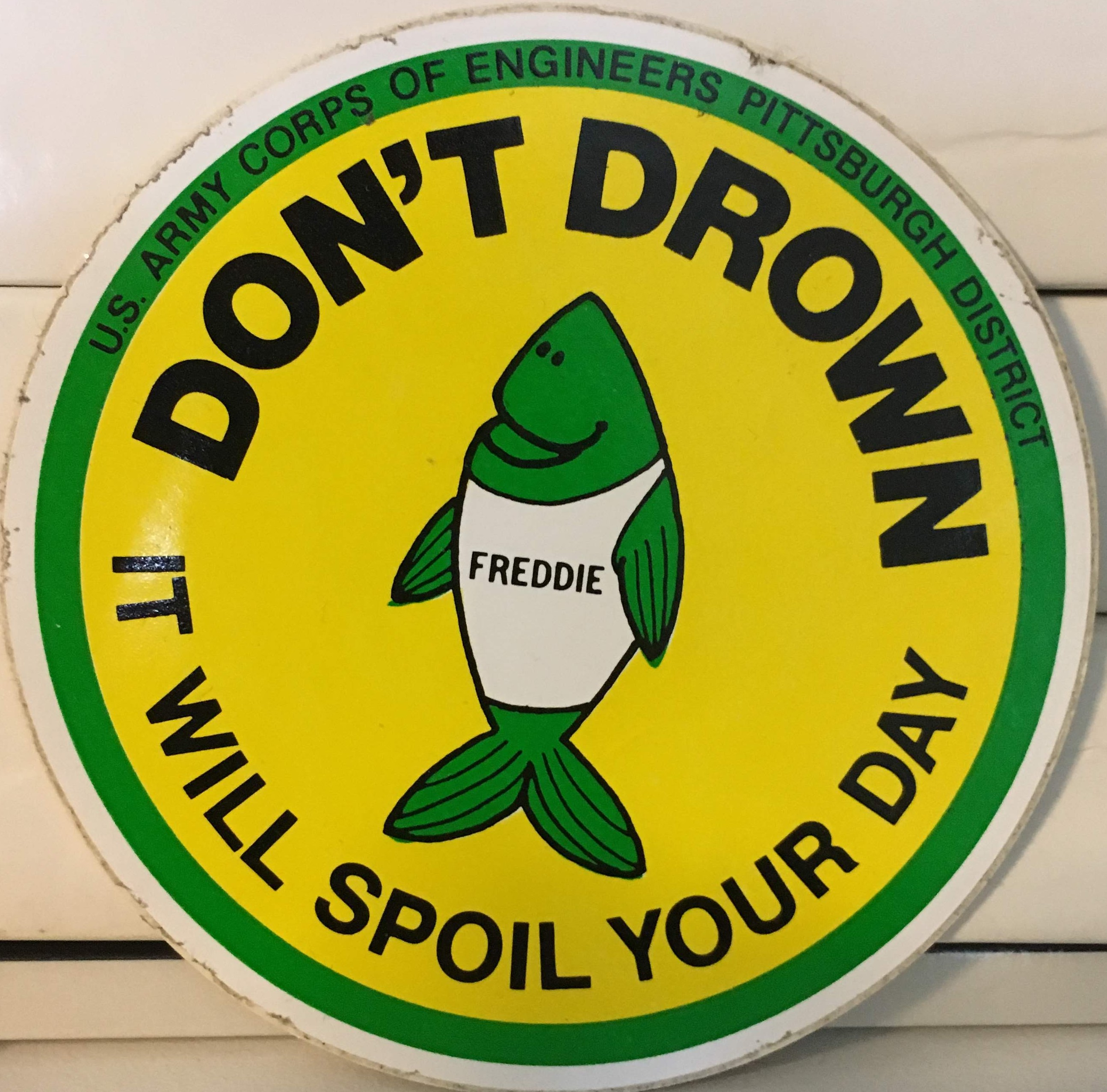
A friendly holiday reminder from the U.S. Army Corps of Engineers, Pittsburgh District from the 1970s.