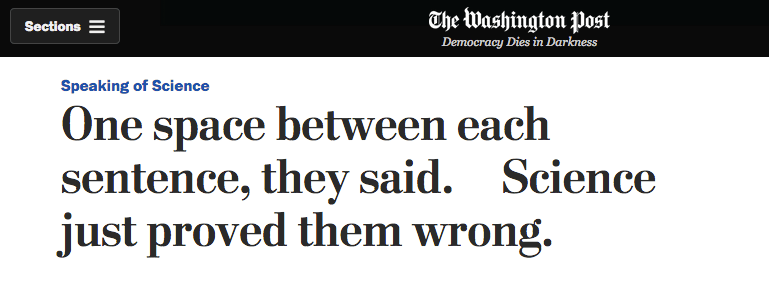
I recommend reading this story, but I don’t recommend believing it.
Here’s why:
You can tell from the headline that it will be fun, and the writer gets to play with using multiple fonts and spacing of letters. It looks like Dada poetry. Dada is often fun. The gist of it is that a scientific study says using two spaces after a period makes a text more readable than one space after a text (though some argue, and I agree, that this two-space rule is a holdover from typewriters and monotype fonts (in which each letter takes up the same width, regardless of it being an “i” or a “w”). With today’s word processors, fonts are no longer monotype (and so two spaces aren’t needed).
First thing, though, is that I was taught as a journalism student that science doesn’t “prove” things; rather, it provides evidence that support theories. So when I read this headline, I think: Bad journalism! (Knowing how hard newspaper work is these days, especially for the copy editors who write the headlines, I can be forgiving. Though it is also this kind of use of the word “prove” in a scientific setting that allows for the slippage between the common understanding of “theory” as meaning a guess and the scientific understanding of the word “theory” as meaning a hypothesis that can be tested to find evidence in support of the hypothesis.)
Then there’s the experiment itself. The sample size—60 students—is far too small for the amount of certainty the story and the headline give it. Again, this is the same kind of bad journalistic reading of science that allowed for the word “proved” to be used in the headline.
Even worse is how the students were tested using a device called the Eyelink 1000, which tracks eye movements as someone reads. As the article states:
Most notably, the test subjects read paragraphs in Courier New, a fixed-width font similar to the old typewriters, and rarely used on modern computers.
In other words, the students were tracked while reading a font for which people should use two spaces after a period, but which most people don’t use.
So which side are you on? One space or two?